Test Your Tank Water
NATA-accredited laboratory testing kits, delivered to your door. Trusted by households, farmstays, B&Bs and rural properties across Australia.
As environmental scientists, we built Safe Water Lab the way we'd want our own water tested.
Featured Products
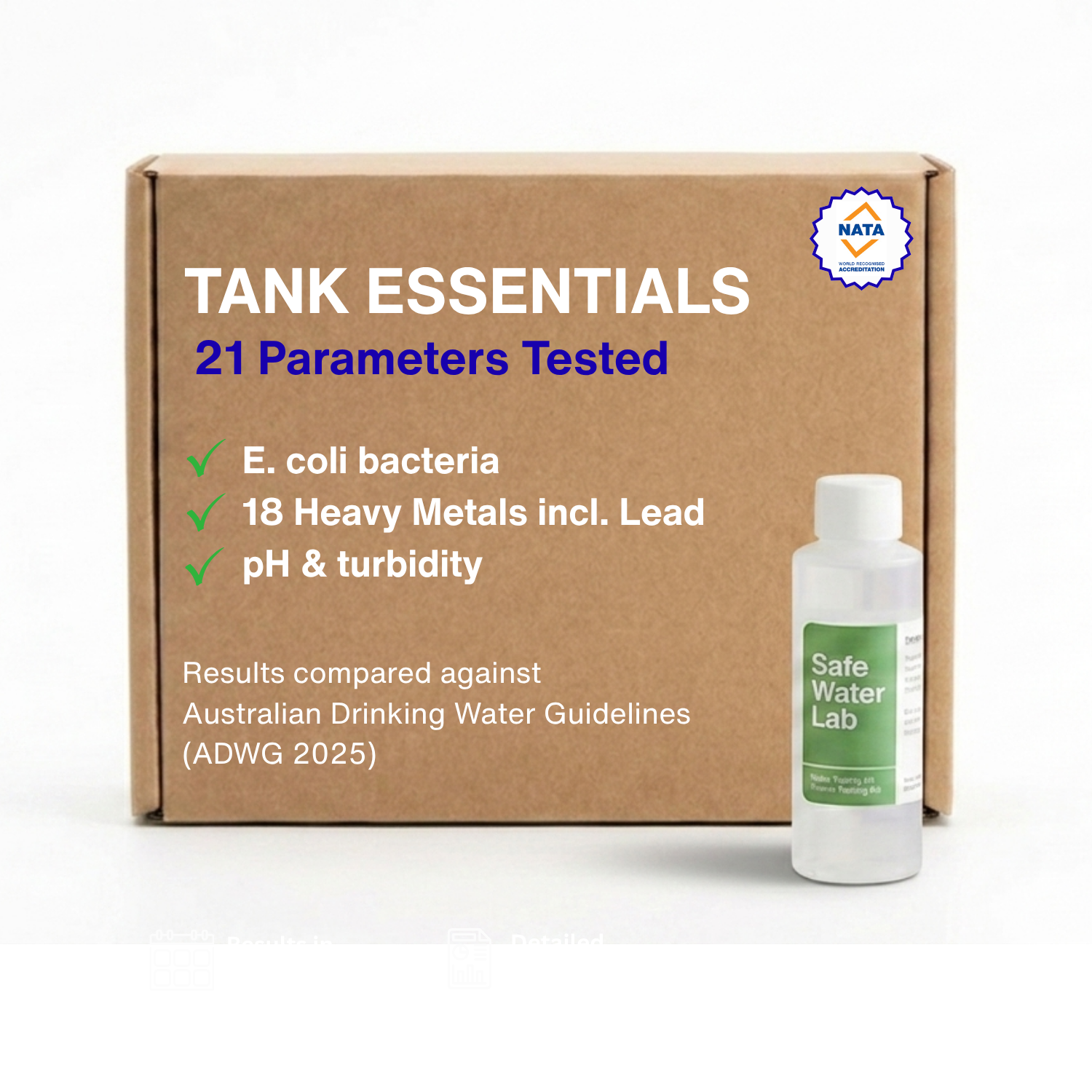
NATA-accredited rainwater tank water testing kit. Mail-in lab analysis covering E. coli, 18 heavy metals including lead, pH and turbidity. All shipping included.
The core safety screen for rainwater tanks.
Tests for E. coli, the metals most likely to leach from roof and gutter catchments, and the basic physical quality indicators. The starting point for any tank supply where full chemistry is not yet a priority.
What's included
Complete sampling kit delivered to your door
All postage, including pre-paid express cold-chain return shipping
NATA-accredited laboratory analysis
Detailed report benchmarked against Australian and International drinking water guidelines
Plain-language exceedance explanations
21 Parameters
E. coli
18 metals & metalloids — Lead, Zinc, Copper, Arsenic, Mercury, Cadmium, Chromium, Nickel, Iron, Manganese, Barium, Cobalt, Silver + more
Turbidity & pH (indicative)
A Note on Bacterial Testing (E. coli & Coliforms)
Bacteria testing is time-sensitive. To get the most precise reading of the water at your tap, the prescribed window for the lab to receive your sample is within 24 hours of collection. Express Post delivery within these timeframes is not always achievable, particularly in regional areas.
To give your sample the best chance of reaching the lab in the shortest possible timeframe:
Collect and post on the same day, early in the week (Monday or Tuesday morning).
Lodge over the counter at the post office before the daily Express Post collection.
What happens if transit takes longer than 24 hours? The laboratory will still test your sample, and the bacterial results will be reported as "indicative." Keep in mind that the longer a sample spends in transit, the less weight those specific E. coli and coliform results carry.
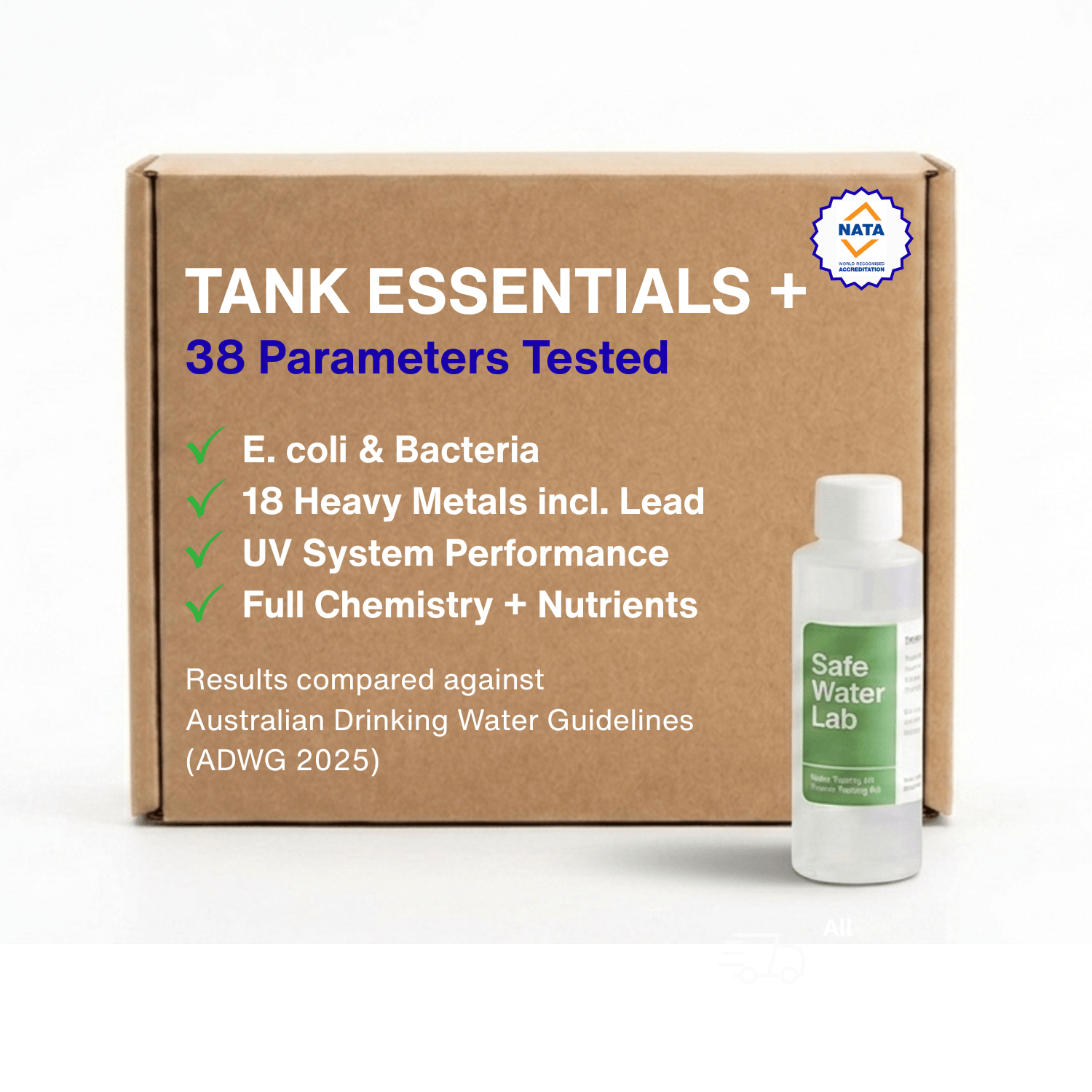
NATA-accredited tank water test kit. Full water profile: microbiology, 18 metals including lead, 14 chemistry parameters, UV system performance and nutrients. Plain-English report.
The recommended starting point for any tank supply used for drinking.
Adds full water chemistry, nutrients from animal waste, apparent colour from tannin staining, and mineral balance to the Basics core.
What's included
Complete sampling kit delivered to your door
Pre-paid express cold-chain return shipping
NATA-accredited laboratory analysis
Detailed report benchmarked against Australian Drinking Water Guidelines (ADWG)
Plain-language exceedance explanations
38 Parameters
E. coli
18 metals & metalloids — Lead, Zinc, Copper, Arsenic, Mercury + 13 others
14 physical & chemical — EC, TDS, Hardness, Alkalinity, Calcium, Magnesium, Sodium, Potassium, Chloride, Sulphate + more
Turbidity, pH (indicative) & Apparent Colour
Nitrate & Ammonia
UV Transmission
→ Compare all tank water kits and see full parameter list
A Note on Bacterial Testing (E. coli )
Bacteria testing is time-sensitive. To get the most precise reading of the water at your tap, the prescribed window for the lab to receive your sample is within 24 hours of collection. Express Post delivery within these timeframes is not always achievable, particularly in regional areas.
To give your sample the best chance of reaching the lab in the shortest possible timeframe:
Collect and post on the same day, early in the week (Monday or Tuesday morning).
Lodge over the counter at the post office before the daily Express Post collection.
What happens if transit takes longer than 24 hours? The laboratory will still test your sample, and the bacterial results will be reported as "indicative." Keep in mind that the longer a sample spends in transit, the less weight those specific E. coli and coliform results carry.
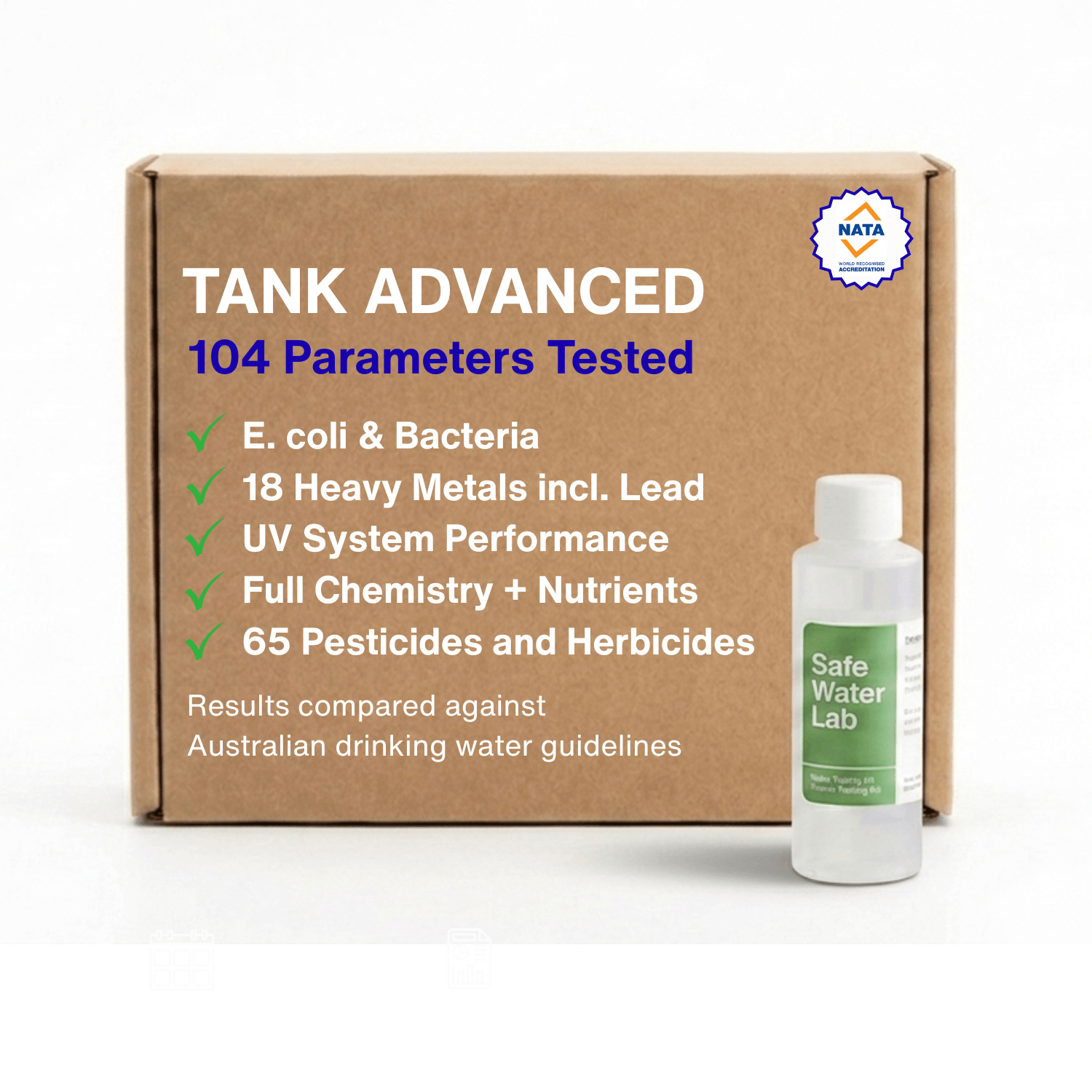
Tank water testing kit for rural properties near farmland. Includes 55 pesticides + 10 triazine herbicides at trace level. NATA-accredited Eurofins lab analysis.
The full Essentials screen plus a 65-compound pesticide, insecticide, and herbicide panel at trace detection level.
For rural and peri-urban properties where agricultural spray drift is a credible risk. Organochlorine compounds including Dieldrin and DDT persist in tank water long after application has ceased. Organophosphate insecticides such as Chlorpyrifos and Diazinon enter through spray drift and are not removed by standard tank filtration.
What's included
Complete sampling kit delivered to your door
Pre-paid express cold-chain return shipping
NATA-accredited laboratory analysis
Detailed report benchmarked against Australian Drinking Water Guidelines (ADWG)
Plain-language exceedance explanations
104 Parameters
E. coli
18 metals & metalloids
14 physical & chemical parameters (incl. EC, TDS, Hardness, Total Alkalinity, Bicarbonate, Carbonate, Hydroxide Alkalinity, Calcium, Magnesium, Sodium, Potassium, Chloride, Sulphate)
Turbidity, pH (indicative) & Apparent Colour
Nitrate & Ammonia
55 pesticides & insecticides at trace level — Organochlorines: Dieldrin, DDT, Heptachlor, Lindane, Endosulfan + others · Organophosphates: Chlorpyrifos, Diazinon, Malathion + others
10 triazine herbicides at trace level — Atrazine, Simazine, Propazine + 7 others
UV Transmission
→ Compare all tank water kits and see full parameter list
A Note on Bacterial Testing (E. coli )
Bacteria testing is time-sensitive. To get the most precise reading of the water at your tap, the prescribed window for the lab to receive your sample is within 24 hours of collection. Express Post delivery within these timeframes is not always achievable, particularly in regional areas.
To give your sample the best chance of reaching the lab in the shortest possible timeframe:
Collect and post on the same day, early in the week (Monday or Tuesday morning).
Lodge over the counter at the post office before the daily Express Post collection.
What happens if transit takes longer than 24 hours? The laboratory will still test your sample, and the bacterial results will be reported as "indicative." Keep in mind that the longer a sample spends in transit, the less weight those specific E. coli and coliform results carry.
How It Works
-
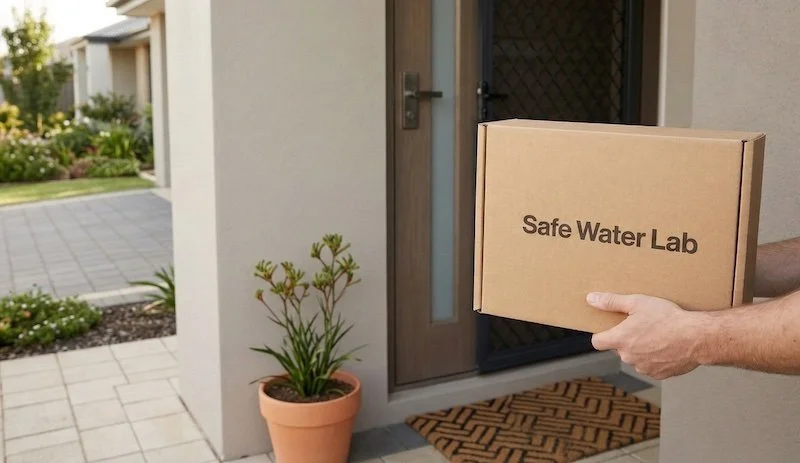
Step 1 - Select and purchase your test
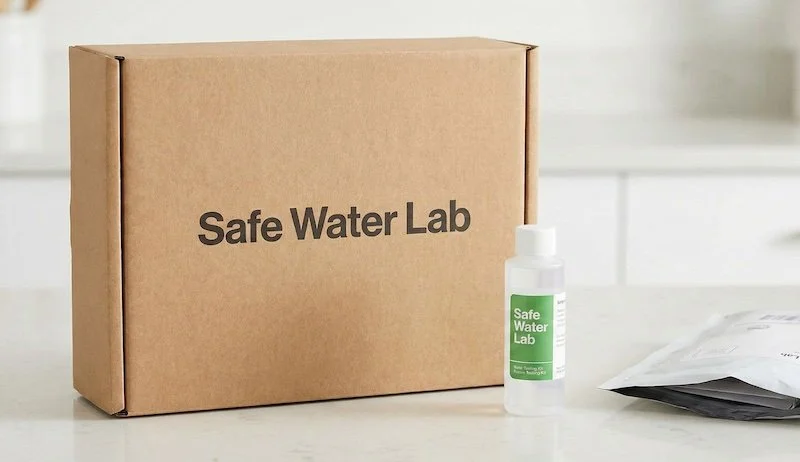
We mail you a testing kit complete with laboratory testing bottles and step by instruction of how to collect your sample.
-
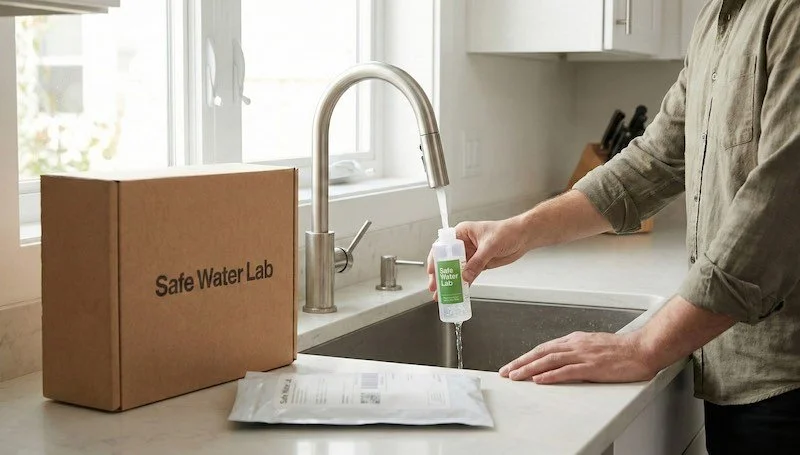
Step 2 - Collect a water sample
Fill the supplied laboratory testing bottles with a sample of your drinking water. Place the bottles in the supplied postage parcel complete with pre-paid express shipping return label and place in post.
-
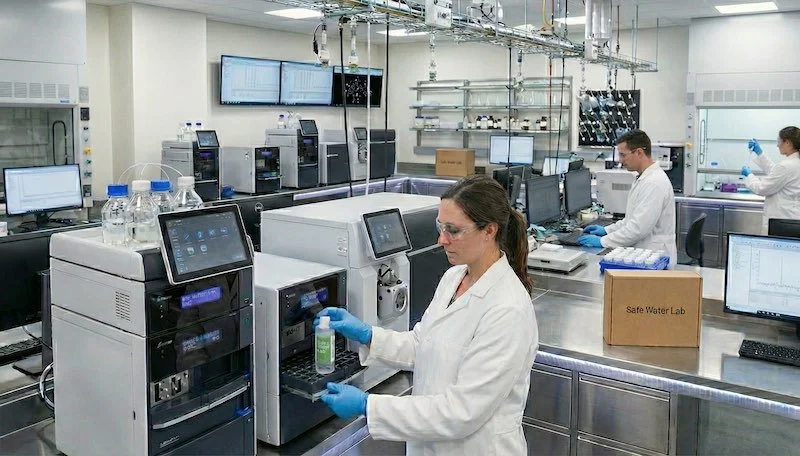
Step 3 - Laboratory Testing
Your water sample will be sent to a NATA accredited Australian laboratory for testing. Our laboratory partners typically complete the analysis within 5 business days.
-
Step 4 - Receive your results
Your detailed Water Quality Analysis Report is delivered as a digital PDF — plain-English results benchmarked against Australian drinking water guidelines, with the original NATA-accredited Certificate of Analysis included.
What We Test
- E. coli and bacteria from bird and possum droppings
- Lead, copper and zinc leaching from roof flashings and gutters
- PFAS from atmospheric deposition near airports and defence sites
- Pesticides and herbicides from agricultural spray drift
- pH and mineral balance — how corrosive your water is to pipes
- Turbidity and colour — sediment and tannin staining
- Hardness and TDS — taste, scale, and appliance impact
- UV transmittance — whether your UV system is actually working
Which tank water kit is right for you?
Every kit screens the harmful contaminants relevant to its tier. Step up only if you want broader coverage of taste, appearance, agricultural chemicals, or PFAS.
What’s Included in Each Test
| 01Microbiology — The Primary Risk | ||||
| E. coli Faecal indicator bacteria — enters through bird and possum droppings, leaf litter, and inadequate first-flush diversion. Tank water has no disinfection residual to suppress bacterial growth. | ✓ | ✓ | ✓ | ✓ |
| 02Roof & Gutter Metal Leaching | ||||
| 18 metals & metalloids — incl. Lead, Zinc & CopperLead (flashing and solder joints), Zinc (galvanised roofing), Copper (gutters and downpipes), Arsenic, Cadmium, Chromium, Mercury, Nickel, Iron, Manganese, Barium, Cobalt, Silver + more. Leaching is highest in the first flush after dry periods. | ✓ | ✓ | ✓ | ✓ |
| 03Nutrients from Animal Waste | ||||
| Nitrate, Nitrite & AmmoniaFrom bird and possum droppings, decomposing leaf litter, and organic debris in gutters. Elevated nutrients also promote bacterial growth inside the tank, compounding microbial risk. | ✕ | ✓ | ✓ | ✓ |
| 04Physical & Aesthetic Quality | ||||
| Turbidity & pHTurbidity from sediment and poor first-flush diversion. pH from rainwater acidity — low pH accelerates metal leaching from tank linings and plumbing. | ✓ | ✓ | ✓ | ✓ |
| Apparent ColourTannin staining from leaf litter and organic debris — one of the most common tank water complaints. | ✕ | ✓ | ✓ | ✓ |
| UV Transmittance (254nm)Measures dissolved organic carbon that affects UV disinfection system performance. A result below 75% indicates your UV system may not be operating at rated effectiveness — useful for households with UV treatment installed. | ✕ | ✓ | ✓ | ✓ |
| 05Mineral Balance & Water Chemistry | ||||
| 14 physical & chemical parametersEC, TDS, Hardness, Total Alkalinity, Bicarbonate, Carbonate, Hydroxide Alkalinity, Calcium, Magnesium, Sodium, Potassium, Chloride, Sulphate. Rainwater is naturally soft and acidic — low mineral content makes it more corrosive to fittings and appliances. | ✕ | ✓ | ✓ | ✓ |
| 06Pesticides, Insecticides & Herbicide Spray Drift | ||||
| 55 pesticides & insecticides at trace detection levelOrganochlorines — Dieldrin, DDT, Heptachlor, Lindane, Endosulfan + others. Organophosphates — Diazinon, Chlorpyrifos, Malathion + others. Persist in water and not removed by standard filtration. | ✕ | ✕ | ✓ | ✓ |
| 10 triazine herbicides at trace detection levelAtrazine, Simazine, Propazine, Terbuthylazine + 6 others. Among the most commonly detected agricultural chemicals in tank water via spray drift. | ✕ | ✕ | ✓ | ✓ |
| 07PFAS — "Forever Chemicals" | ||||
| 30 PFAS compounds at trace detection levelPFOS, PFOA, PFHxS, PFNA + 26 precursors at 0.001–0.005 µg/L. Enters tank water near defence bases, airports, and industrial sites through atmospheric deposition. The 2025 ADWG tightened limits by up to 94%. | ✕ | ✕ | ✕ | ✓ |
| What's Included | ||||
| Complete sampling kit delivered to your door | ✓ | ✓ | ✓ | ✓ |
| Pre-paid express cold-chain return shipping | ✓ | ✓ | ✓ | ✓ |
| NATA-accredited laboratory analysis (No. 1261) | ✓ | ✓ | ✓ | ✓ |
| Colour-coded PDF report benchmarked against ADWG | ✓ | ✓ | ✓ | ✓ |
| Plain-language exceedance explanations | ✓ | ✓ | ✓ | ✓ |
| Total parameters tested | ~21 | ~38 | ~104 | ~134 |
What's actually in my rainwater — and is it safe for my family?
Order Now — A$499Could spray drift from nearby farms be in my tank water?
Order Now — A$749Is there PFAS in my tank water from a nearby base or airport?
Order Now — A$949Every contaminant class in a single kit — metals, PFAS, pesticides, herbicides, VOCs, PAHs, microbiology, nutrients, and disinfection by-products. Trace-level detection throughout. Works on any water source.
Lead, copper, zinc, arsenic, mercury, chromium and 12 more — standalone screen for roof and gutter catchment contamination pathways.
PFOS, PFOA, PFHxS + 27 precursors at trace detection (0.001–0.005 µg/L). For properties near defence bases, airports, or industrial sites.
PE, PP, PS, PVC, PET, PC, PMMA, PA particle counts in potable water. No safe limit has been set under the ADWG — we report what's present so you can make an informed decision.
All analysis performed by NATA-accredited laboratories under ISO/IEC 17025:2017 · All prices include GST · Cold-chain return shipping included
“We used this kit to check our rainwater for E. coli and heavy metals to ensure our filters were doing their job. Testing was incredibly easy, and the clear results gave us the confidence we were looking for.”
— M.C., St Andrews, VicTank Water Risks Explained
Rainwater tanks have no disinfection and no regulatory monitoring. What's in your tank depends entirely on your roof, your gutters, and what's in the air above your property.
Show 4 more categories we test
Why Testing Matters
What we actually find in tank water
Rainwater can look and taste perfectly clean while carrying the things that matter most — and you can't see, smell or taste any of them. Here's what a quarter-century of Australian tank-water research consistently shows, and what a Safe Water Lab analysis is built to catch.
49%
of tested rainwater tanks contained E. coli — the standard indicator of faecal contamination, typically washed in from birds, possums and debris on the roof.
28%
exceeded the lead health guideline — almost always leached from the tank system's own metal components rather than from the rainwater itself.
Pooled findings from Zanotto & Senevirathna (2025), a scoping review of roughly 25 years of Australian rainwater-tank studies (Environmental Challenges). A detection isn't a diagnosis — but the pattern is remarkably consistent across decades of testing, and none of it is visible from the tap.
And the contaminants you can't anticipate
PFAS — the so-called "forever chemicals" — reach rainwater tanks through atmospheric deposition, settling onto the roof and washing into the tank. In 2025 Australia significantly tightened its drinking-water limits for PFAS, so a result that once sat comfortably below guideline may not any more. We screen for PFAS, pesticides and volatile organics in our Advanced and Complete analyses.
How one result explains another
A single number rarely tells the whole story. This is a real (anonymised) Tank Advanced result — watch how four parameters connect into one diagnosis:
Catchment
Organic load
Colour 30 HU
Leaf litter and gutter debris dissolve into the water.
Chemistry
Acidic water
pH 5.6
Organic acids drive the pH well below the guideline range.
Chemistry
Corrosive water
No buffering
Soft, acidic water dissolves metal on contact (plumbosolvency).
Every Safe Water Lab report reads the chemistry as a connected system, in plain language, benchmarked against the Australian Drinking Water Guidelines — and tells you what, if anything, to do about it.
Independent Testing Run by Environmental Scientists
We test rainwater tank water for the contaminants that actually matter — bacteria from roof catchment, metals leaching from flashing and gutters, PFAS from atmospheric deposition, and pesticide drift from surrounding land. Many of these aren't routinely included in other water tests on the market. Your results are interpreted by environmental scientists and benchmarked against the Australian Drinking Water Guidelines, so you can make an informed decision about your water.
We don't sell filtration systems, water softeners, or treatment products. Our job is to give you an accurate picture of what's in your water — what you do next is up to you. Many of our customers don't need any treatment at all once they see the results.
E. coli and thermotolerant coliforms cultured under accredited method. Lead, copper, and zinc quantified to µg/L. PFAS detected to 0.001 µg/L — well below current Australian guideline values. Pesticides and herbicides at trace level. The full picture, at the accuracy required to make decisions.
Safe Water Lab is operated by environmental scientists with backgrounds in water quality and contaminated land. Every kit is specified for tank water — we test for the contaminants that actually matter, choose the right test method and detection limit for each one, and write sampling instructions so the result reflects what's really in your tank. Every report is read by someone who understands what the numbers mean, before it reaches you.
Every result is colour-coded and compared against the Australian Drinking Water Guidelines. Where a parameter exceeds a guideline, we explain what it means, what's likely causing it, and what your options are — in plain English.
- ✕Cannot detect PFAS, pesticides, or solvents
- ✕Lead detection limits 100× higher than the guideline
- ✕No measurement of bacteria — only chlorine residual, which tank water lacks anyway
- ✕Colour-match accuracy varies by user and lighting
- ✓Up to 134 parameters at trace detection levels
- ✓Lead, copper, and 16 other metals quantified to µg/L
- ✓E. coli and thermotolerant coliforms cultured under accredited method
- ✓Results signed off by an accredited laboratory — auditable, traceable, defensible
Test strips are useful for swimming pools and aquariums. For drinking water that contains contaminants at parts-per-billion concentrations, you need a laboratory.
Your Report
Not raw data. A verdict on your water
— with a clear path forward.
Most lab tests return a spreadsheet of numbers with no context. Your Safe Water Lab report is different — it tells you what was found, what it means for your household, and exactly what to do about it.
At-a-glance results summary
Your report opens with a colour-coded overview table. One page tells you which categories are clear and which need attention — before you read a single technical result.
Built to be understood in under a minute, by anyone.
Every result benchmarked
Each result is shown alongside the official guideline limit, with a plain-English status — below guideline, below detection, or exceeds limit. Not a number without context. A clear answer.
Benchmarked against the Australian Drinking Water Guidelines (ADWG, updated June 2025) and World Health Organization (WHO) guidelines.
Plain-English expert interpretation
Anything outside guidelines gets its own dedicated write-up — what it means, what likely caused it, and how it relates to the rest of your results. Written by environmental scientists, not generated from a template.
Interpretation tailored to your specific result, not a stock paragraph.
Specific next steps — not generic advice
Where action is needed, the report tells you precisely what to do and which professional to call — not "consult a professional." Step-by-step guidance built around your actual results, in the order you should tackle them.
A practical action plan, not a list of warnings.
The original NATA lab certificate
Your report includes the full laboratory Certificate of Analysis — the primary analytical record, with accreditation numbers, authorising signatures, and method references. This is the document that holds legal and insurance weight.
Issued by a NATA-accredited laboratory, ISO/IEC 17025 certified.
A PDF you own — forever
Delivered as a professional branded PDF to your inbox. Share it with your plumber, water treatment specialist, real estate agent, or insurer. No login portal, no expiry, no third-party platform. Just a document you own and can use.
Delivered within 5–7 business days of your sample arriving at the lab.
Analysis is performed by leading NATA-accredited laboratories, certified to ISO/IEC 17025 — the international standard for testing competence. Your Safe Water Lab report translates that accredited laboratory data into a document you can understand and act on.
See it for yourself
A real Safe Water Lab report — every page, start to finish.

The same laboratories trusted by Australian councils, water utilities, and environmental regulators.
Tank Water - Common Questions
-
The Australian residential water filter market operates without mandatory product certification or independent performance verification. Manufacturers are not required to substantiate contaminant removal claims before bringing a product to market — meaning the performance figures on the packaging are largely self-reported. A NATA-accredited laboratory baseline provides the only objective, scientifically defensible audit of whether your filtration system is performing as claimed, or creating a false sense of security.
-
It is incredibly simple. When your kit arrives, it includes step-by-step instructions. You simply fill the provided bottles from your tap, write the date on the included form, and place everything into the pre-paid express return mailer. Drop it at any Australia Post Express Post collection point, and you are done.
-
Our laboratory partner completes analysis within 5 business days of receiving your sample. Your report is typically delivered by email 1–2 business days after that. Total time from posting your sample to receiving results is around 7–9 business days depending on postal transit.
-
As a general guide, annual testing is appropriate for most household tanks used for drinking. You should also test after any significant event — a prolonged dry spell followed by heavy rain, roof repairs, storm damage, or if you notice any change in taste, colour, or odour. If you have young children, elderly residents, or immunocompromised people in the household, more frequent testing is warranted.
-
For most households, Tank Essentials covers the core risks — microbiology, metals from roof catchment, water chemistry, nutrients, and physical quality. If your property is rural or peri-urban with nearby cropping or horticulture, Tank Complete adds a 54-compound pesticide screen. If you are near a defence base, airport, or industrial site, Tank Advanced adds PFAS testing at trace detection levels.
-
For most operators, Essentials covers base ADWG compliance — microbiology, metals, core chemistry, and nutrients. If your property is near agricultural cropping or spray operations, Advanced adds pesticides and herbicides. If you're near a defence base, airport, or industrial site, Complete adds PFAS.
Before you order check the following so the result does what you need it to:
Ask your regulator what they require. Councils and health districts usually specify which parameters must be tested and against which standard. Confirm that first, and we'll match a kit — or a tailored panel — to their list.
Check how the sample must be collected. Some regulators require sampling to a defined protocol, or by an independent party, rather than a self-collected sample. If that applies to you, let us know and we can arrange it.
Confirm the turnaround and holding times suit your timeframe. Microbiology in particular has a short holding time, so for compliance sampling the collection-to-lab timing matters — we'll walk you through getting this right.
Not sure what your council is asking for? Get in touch through our Commercial Testing page and we'll help you scope it before you order.