Farm and Rural Water Testing
Your water
Tested. Reported.
No consultant
Mail-order water testing for rural properties, lifestyle farms, and equestrian holdings. NATA-accredited laboratory analysis delivered to your door — no site visit, no agronomist required.
For bore, dam, creek, and surface water used for irrigation, horses and livestock, or pre-purchase property assessment.
What we do
Order a kit, collect your sample, and send it back. Your water is analysed by a NATA-accredited laboratory and you receive a full results report within 5–7 business days from when samples received by laboratory. No consultant, no site visit, no minimum order.
Groundwater from bores and wells used for irrigation, livestock, or drinking. No disinfection or regulatory monitoring applies — quality is determined by aquifer geology and local land use history.
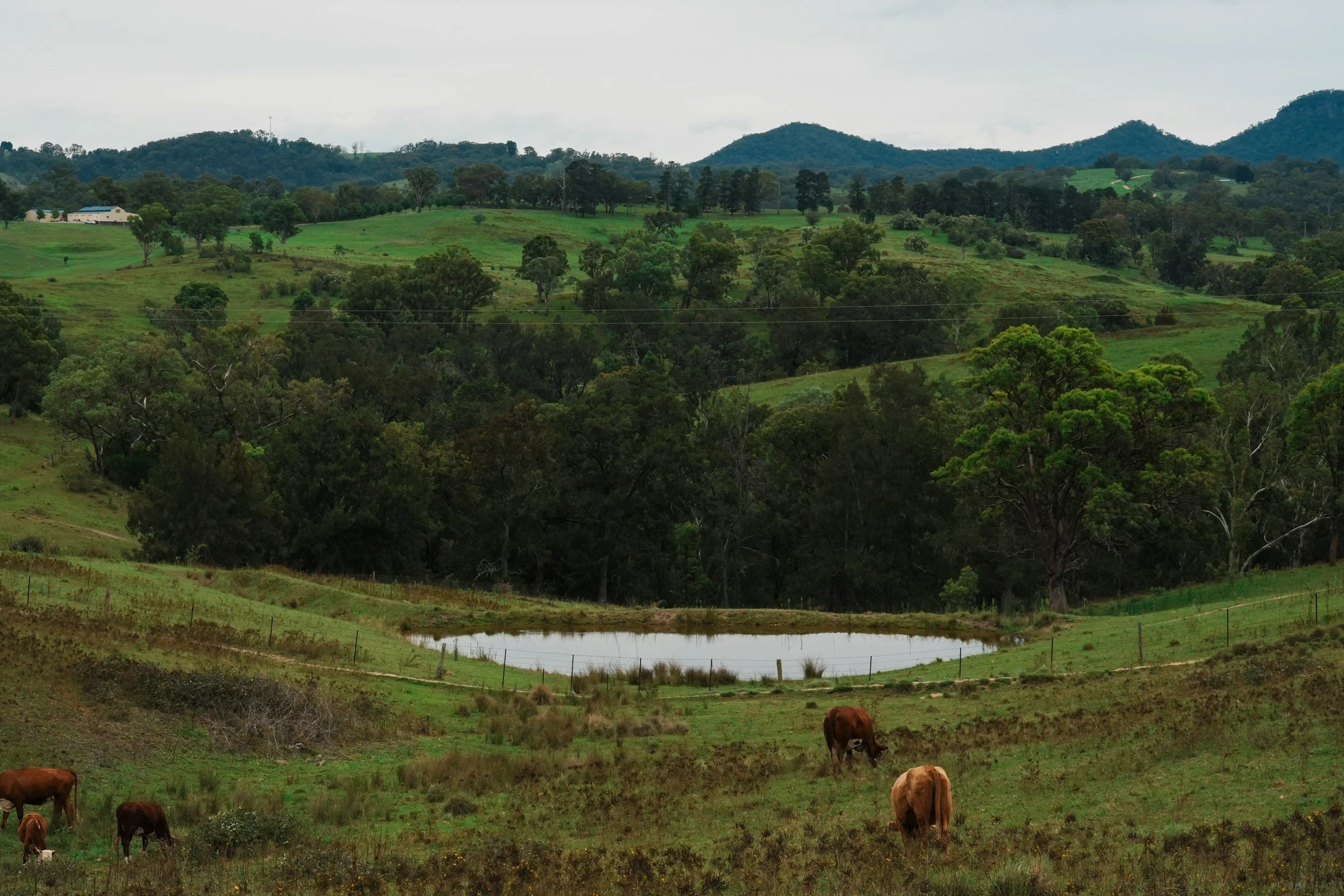
On-farm dams and storage ponds used for irrigation or livestock watering. Quality varies seasonally — concentration of salts, nutrients, and bacteria increases as water levels fall.
Surface water drawn directly from creeks, rivers, or natural watercourses. Chemistry and microbiological quality vary with rainfall events, upstream land use, and seasonal flow.
Reticulated irrigation supply and on-farm channel networks. Water quality at the delivery point can differ significantly from the supply source — salinity, iron, and sediment load accumulate in transit.
Horses are sensitive to water palatability — elevated iron, salinity, or sulfur will reduce voluntary intake before clinical signs appear. Bore and dam sources used for horses warrant the same scrutiny as human drinking water sources.
Trough water quality can differ from the source — biofilm, sediment, algal growth, and sun exposure affect microbiological and chemical quality. Collect from the trough if trough-point quality is the concern.
On-farm rainwater collection used for drinking, spray mixing, or supplementary irrigation. Roof material, guttering condition, and tank age all affect lead, copper, and microbiological quality.
Comparing bore, dam, and rainwater sources across the same property in a single submission. The property audit kits cover three or five sources; the 5-Point Irrigation Audit covers any combination of five irrigation sources.
What are you testing for?
Each kit is designed around a specific question. Find yours below, then scroll to the comparison table to see exactly what's included.
01
Will this water damage my crops, block my emitters, or salt my soil?
Salinity, SAR, iron, manganese, and boron — the parameters that determine whether bore or dam water is suitable for crops, orchards, pasture, and drip irrigation systems. Relevant for any property where the irrigation water source has not previously been tested.
02
Is this water safe for my horses, cattle, or sheep?
E. coli, nitrate, nitrite, fluoride, salinity, and a full 14-metal suite — the parameters that affect animal health, voluntary water intake, and production performance. Relevant for bore, dam, and creek sources used for stock water where no monitoring is in place.
03
I'm buying, or have recently purchased, a rural property
The property audit kits test each water source on the property in a single submission — bore assessed against drinking, irrigation, and livestock standards simultaneously; tank against drinking water standards; dam or creek against irrigation and livestock standards.
04
I need to compare water sources before committing to infrastructure
The 5-Point Irrigation Audit maps salinity, sodium hazard, iron, and manganese across any combination of five bore, dam, or surface water sources in a single submission — before pump selection, pipe layout, or drip system installation.
Farm Water Testing Kits
Five kits, each built around a specific question. The entry screens — irrigation suitability and livestock safety — cover a single source. The property audit kits cover three or five sources in a single submission, with each source assessed against the standard relevant to its intended use. The 5-Point Irrigation Audit maps quality across up to five bore, dam, or surface water sources before infrastructure decisions are made. Select the kit that matches your situation, or use the guide above if you're not sure where to start. All kits include prepaid express return shipping, NATA-accredited laboratory analysis, and a plain-English results report compared against the relevant published Australian and international standard.
Will this water stain my property, block my emitters, or salt my soil?
A$439 inc. GST · return shipping included Order NowIs this water safe for horses, cattle, sheep, or poultry?
A$549 inc. GST · return shipping included Order NowThree sources, one submission. The standard pre-purchase water assessment.
A$1,299 inc. GST · return shipping included Order NowFive sources, one submission. For larger or more complex properties.
A$1,549 inc. GST · return shipping included Order NowWill this water stain my property, block my emitters, or salt my soil?
A$439 inc. GST · return shipping included Order NowIs this water safe for horses, cattle, sheep, or poultry?
A$549 inc. GST · return shipping included Order NowThree sources tested in a single submission — bore, tank, and dam or creek.
A$1,299 inc. GST · return shipping included Order NowFive sources tested in a single submission — for larger or more complex properties.
A$1,549 inc. GST · return shipping included Order NowMap salinity and iron risk across all sources before investing in irrigation infrastructure.
A$1,199 inc. GST · return shipping included Order NowAll prices include GST · Return shipping included · NATA-accredited laboratory analysis · Results compared against ANZECC/ARMCANZ 2000, FAO irrigation guidelines, and ADWG V4.0 as applicable · Results within 5–7 business days of laboratory receipt
How It Works
-
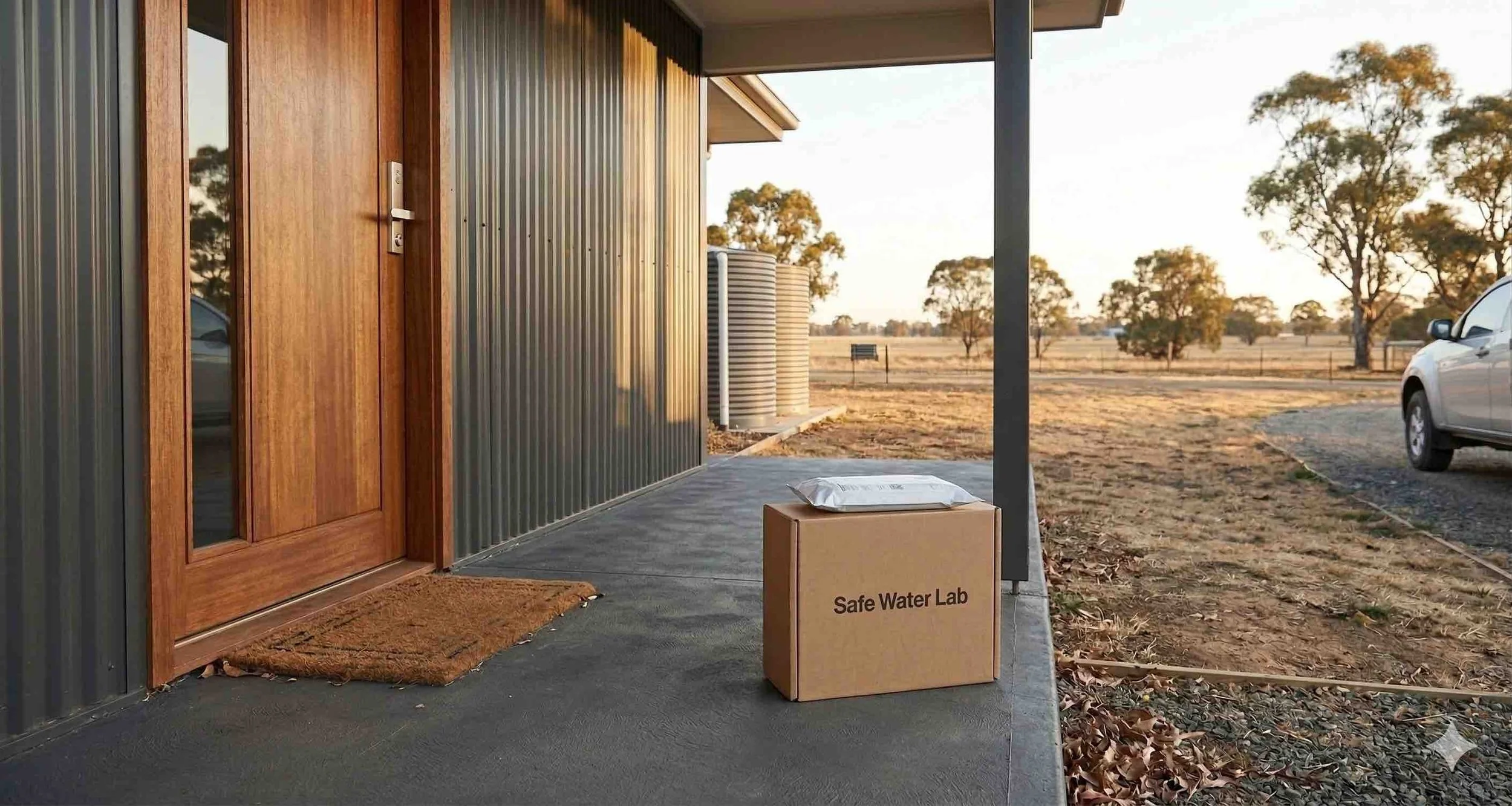
Step 1 - Select and purchase your test
We mail you a testing kit complete with laboratory testing bottles and step by instruction of how to collect your sample.
-
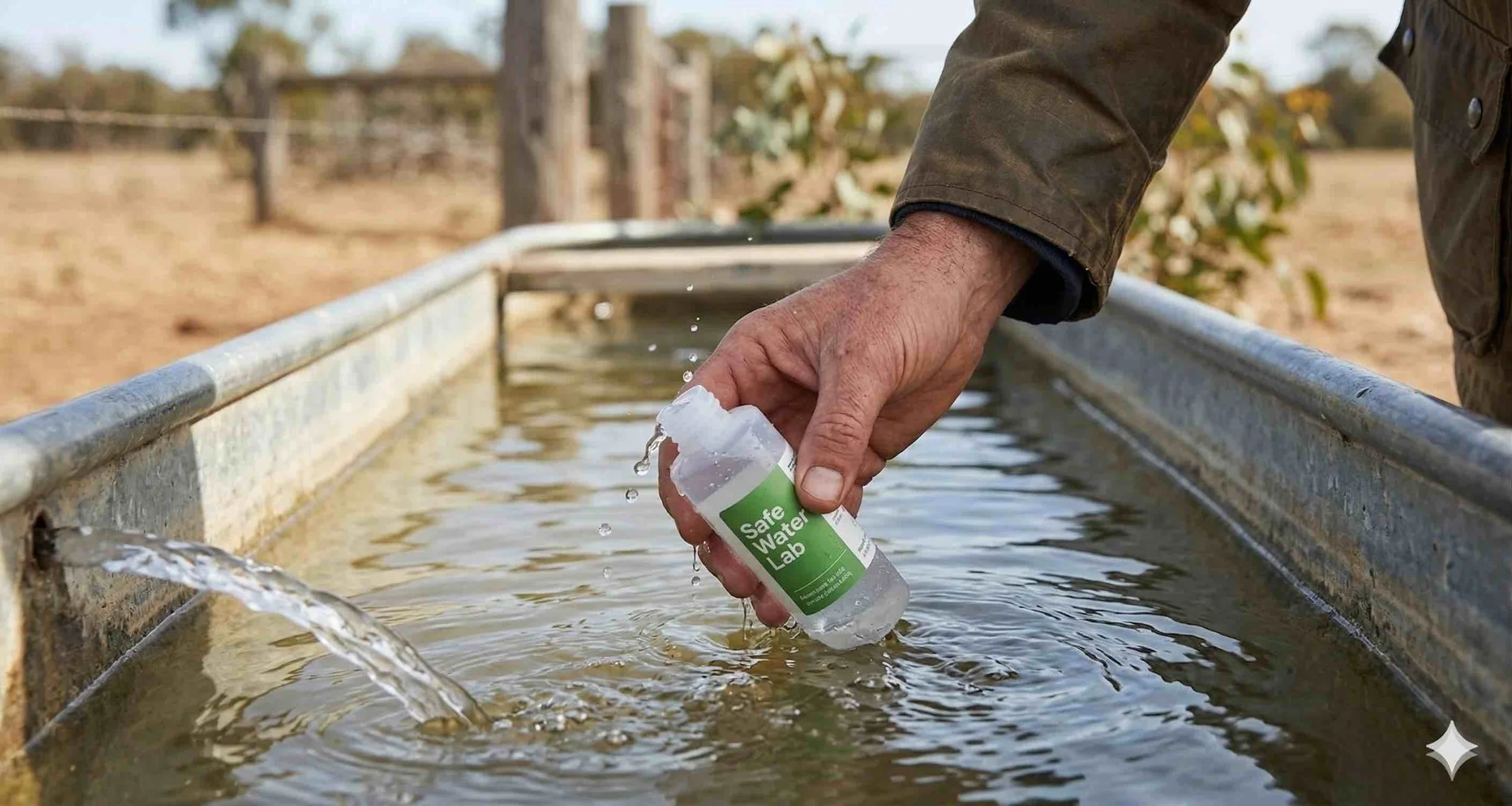
Step 2 - Collect a water sample
Fill the supplied laboratory testing bottles with a sample of your water. Place the bottles in the supplied postage parcel complete with pre-paid express shipping return label and place in post.
-

Step 3 - Laboratory Testing
Your water sample will be sent to a NATA accredited Australian laboratory for testing. Our laboratory partners typically complete the analysis within 5 business days.
-
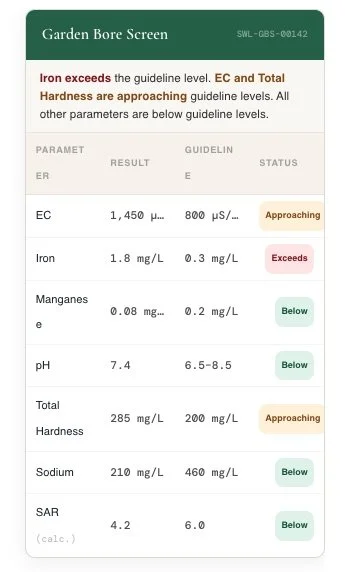
Step 4 - Receive your results
Your detailed Water Quality Analysis Report is delivered as a digital PDF — plain-English results benchmarked against Australian and international guidelines for irrigation, livestock, and drinking water suitability, with the original NATA-accredited Certificate of Analysis included.
Your Results
| Parameter | Result | Guideline | Status |
|---|---|---|---|
| E. coli | <1 CFU/100mL | 0ADWG V4.0 [H] | Below |
| EC | 1.8 dS/m | 1.3–2.9 dS/mANZG 2023 medium salinity | Medium |
| Iron | 0.65 mg/L | 0.2 mg/LANZG 2023 DGV | Exceeds |
| Manganese | 0.04 mg/L | 0.2 mg/LANZG 2023 DGV | Below |
| SAR (calc.) | 5.1 | 3–9 slight restr.ANZG 2023 / FAO 29 | Slight restr. |
| Fluoride | 1.3 mg/L | 1.5 mg/LADWG V4.0 [H] | Approaching |
| Nitrate (as N) | 2.8 mg/L | 11.3 mg/LADWG V4.0 [H] | Below |
| Arsenic | 0.003 mg/L | 0.01 mg/LADWG V4.0 [H] | Below |
| Glyphosate | <0.01 µg/L | 1,000 µg/LADWG V4.0 [H] | BDL |
| Parameter | Result | Guideline | Status |
|---|---|---|---|
| E. coli | <1 CFU/100mL | 0ADWG V4.0 [H] | Below |
| pH | 6.1 | 6.5–8.5ADWG V4.0 [A] | Outside range |
| Lead | 0.004 mg/L | 0.005 mg/LADWG V4.0 [H] | Approaching |
| Copper | 0.14 mg/L | 1.0 mg/LADWG V4.0 [A] | Below |
| Zinc | 0.6 mg/L | 3.0 mg/LADWG V4.0 [A] | Below |
| Turbidity | 0.4 NTU | 1 NTUADWG V4.0 [A] | Below |
| Manganese | 0.02 mg/L | 0.05 mg/LADWG V4.0 [A] | Below |
| Parameter | Result | Guideline | Status |
|---|---|---|---|
| E. coli | 85 CFU/100mL | 10–100 mod. riskANZECC/ARMCANZ 2000 | Mod. risk |
| EC | 0.9 dS/m | 0.65–1.3 dS/mANZG 2023 low salinity | Low |
| Iron | 0.42 mg/L | 0.2 mg/LANZG 2023 DGV | Exceeds |
| Manganese | 0.06 mg/L | 0.2 mg/LANZG 2023 DGV | Below |
| Nitrate (as N) | 1.9 mg/L | —ANZECC/ARMCANZ 2000 | Below |
| Fluoride | 0.4 mg/L | 2.0 mg/LANZECC/ARMCANZ 2000 | Below |
| Turbidity | 22 NTU | —No irrigation guideline | Note |
Illustrative results only · Your report includes all tested parameters with measured values, detection limits, and guideline comparisons · NATA-accredited Certificate of Analysis included · Benchmarks: ADWG V4.0 · ANZG 2023 (Chapter 9.2) · ANZECC/ARMCANZ 2000
Every kit includes a colour-coded results report comparing each measured parameter against the relevant Australian guideline for how that water will be used — drinking, irrigation, or livestock — so you can see at a glance what was found and whether it's within the accepted range.
The 3-Point Property Audit applies all three sets of standards in a single report, matched to each source. The bore is assessed against drinking, irrigation, and livestock standards simultaneously. The rainwater tank against drinking water standards. The dam or creek against irrigation and livestock standards.
Specific references: Australian Drinking Water Guidelines V4.0 (ADWG V4.0) for drinking water; ANZG 2023 Chapter 9.2 for irrigation; ANZECC/ARMCANZ 2000 Chapter 4.3 for livestock.
Your report includes a formatted results PDF with all parameters, measured values, units, detection limits, and guideline comparisons, plus the original NATA-endorsed certificate of analysis — the formal laboratory record of your results.
Common Questions
Single source, irrigation focus — Irrigation Suitability Screen ($439 inc. GST). Salinity, SAR, iron, manganese, and boron — the parameters that determine whether bore or dam water is suitable for crops, orchards, pasture, and drip irrigation systems.
Single source, horses or livestock — Livestock & Equine Water Screen ($549 inc. GST). E. coli, nitrate, nitrite, fluoride, salinity, and a full 14-metal suite compared against ANZECC/ARMCANZ 2000 livestock guidelines.
Buying or settling on a rural property — 3-Point Property Audit ($1,299 inc. GST). Bore, rainwater tank, and dam or creek tested in a single submission, each assessed against the standard relevant to its intended use.
Larger or more complex property — multiple bores, dams, or seasonal creeks — 5-Point Property Audit ($1,549 inc. GST). Five sources, single submission.
Multiple irrigation sources to compare before infrastructure decisions — 5-Point Irrigation Audit ($1,199 inc. GST). Salinity, SAR, iron, manganese, and boron mapped across any combination of five bore, dam, or surface water sources.
The Livestock & Equine Water Screen tests a single water source — one bore, dam, trough, or creek — against ANZECC/ARMCANZ 2000 livestock guidelines. It's designed for an existing property owner who wants to know whether a specific source is suitable for their animals.
The 3-Point Property Audit tests three separate sources in a single submission — typically bore, rainwater tank, and dam or creek — with each source assessed against the standard relevant to how it will actually be used. The bore is compared against drinking, irrigation, and livestock standards simultaneously. The rainwater tank against drinking water standards. The dam or creek against irrigation and livestock standards.
If you are buying a property or have recently purchased one and want a complete picture of all your water sources, the property audit is the right choice. If you own the property and have a specific concern about one source, the single-source screen is more appropriate.
If your property has more than three water sources — a second bore, a seasonal creek, a header tank — the 5-Point Property Audit covers up to five sources in the same single submission.
PFAS testing is worth considering if your property is near any of the following:
— A RAAF base or civilian airport (PFAS-containing firefighting foam was used at most Australian airfields)
— A former fire training ground
— Industrial land with a history of manufacturing, chemical processing, or AFFF use
— Agricultural land with a history of biosolid (sewage sludge) application
PFAS compounds migrate from surface contamination into groundwater and persist indefinitely. They are colourless, odourless, and tasteless at concentrations that exceed guideline values — physical appearance of the water gives no indication of PFAS presence.
Contact us to discuss PFAS testing options for your property.
Dam water — collect from just below the water surface, at least one metre from the bank. Avoid disturbing bottom sediment. If water is drawn from depth via a pump, collecting from the pump outlet is acceptable and often more representative of the water your livestock or irrigation system actually receives.
Creek or river — collect mid-stream, at the point of use, away from banks and still water. Avoid collecting during or immediately after heavy rain events — results during runoff conditions are not representative of baseline water quality.
Microbiology bottles require special handling — see the holding time note below the kit tables for dispatch instructions.
High-SAR water applied to soil over time causes sodium to displace calcium and magnesium from soil particles. The result is progressive soil structural breakdown — reduced permeability, surface crusting, and compaction — which reduces water infiltration and can make soils difficult to work. The effect is most pronounced on clay and clay-loam soils and accumulates over multiple irrigation seasons.
SAR is compared against FAO irrigation guidelines in all kits that include irrigation chemistry. It is one of the most important parameters for assessing long-term bore water suitability for irrigation.
Most of the parameters that matter for irrigation — sodium hazard (SAR), elevated boron, residual herbicides — are colourless and tasteless at agronomically significant concentrations. Arsenic, fluoride, nitrate, and PFAS produce no noticeable change to the appearance, smell, or taste of water at concentrations that exceed their respective guideline values. E. coli contamination is similarly undetectable without testing.
Bore water in Australia has no regulatory monitoring requirement. Nobody is checking it on your behalf.
We report the results and the comparison against the published standard. We don't make suitability determinations — that assessment is for you, in consultation with your health professional, based on the factual results your report contains. The NATA-endorsed certificate of analysis included with every report is the formal record of your results.
Re-testing is worth considering after:
— A significant flood or heavy rainfall event (particularly for dam and surface water)
— Nearby agricultural chemical application
— A change in neighbouring land use (new feedlot, new irrigated crop, earthworks)
— Noticeably different water appearance, taste, or odour
— Any change to the bore itself — new pump, deepened, or recased
For livestock water from dams or creeks, biannual testing — before summer and before winter — gives a more complete picture of seasonal variation.
Collect and post on a Monday or Tuesday only, using the included Express Post prepaid return bag. This ensures your sample reaches the laboratory before the end of the working week. Samples collected Wednesday through Sunday cannot reliably meet the 24-hour requirement via AusPost Express.
Customers in major cities and towns with direct AusPost Express connections generally meet the holding time. Customers in remote or rural locations should be aware that transit times may exceed 24 hours despite express posting — in this case your microbiology result is reported as indicative rather than NATA-certified.
All chemistry, metals, and herbicide parameters are unaffected by transit time and are reported to full NATA accreditation regardless of when your sample arrives.