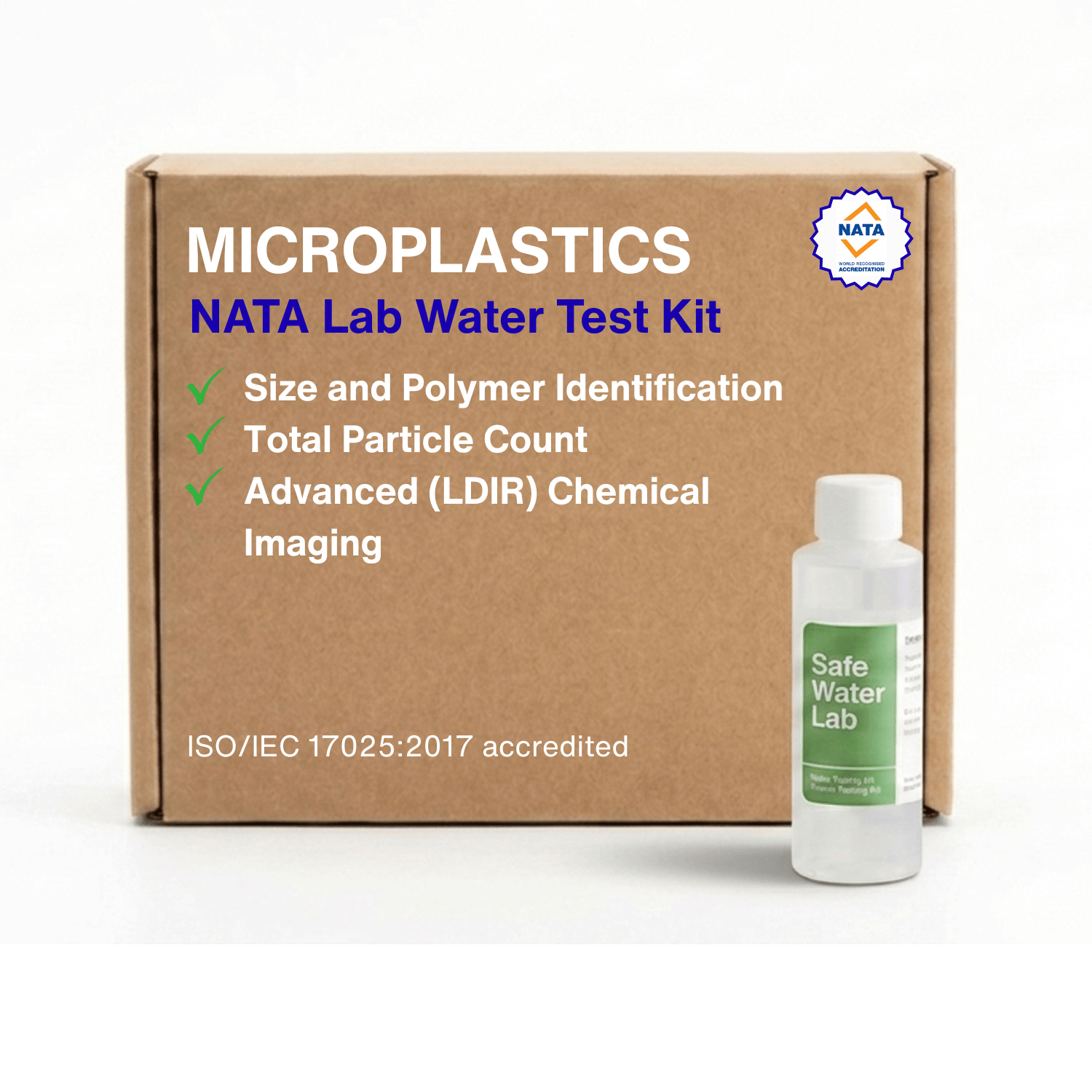
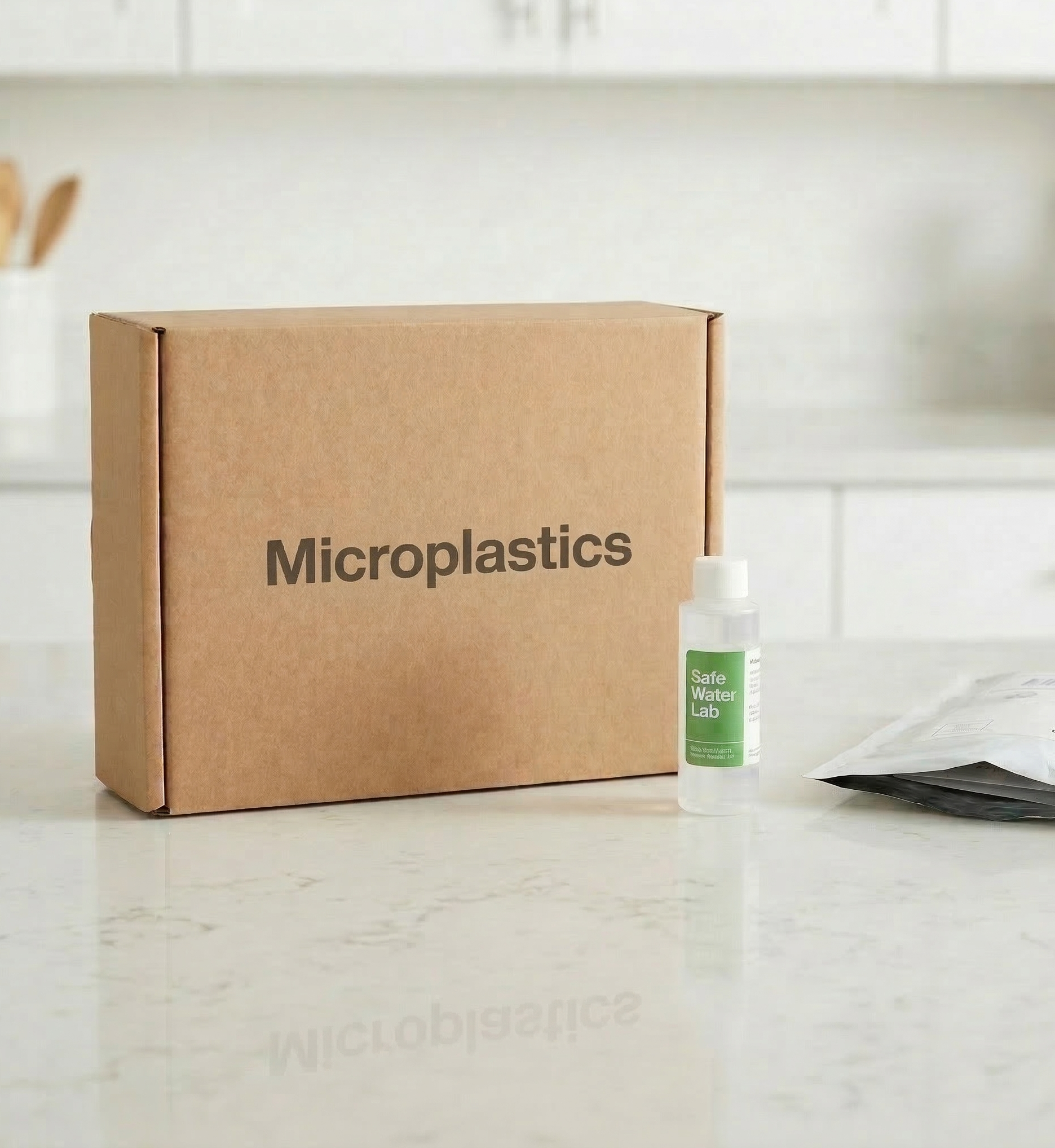
Specialist microplastics water testing kit. Particle counts for 8 polymer types: PE, PP, PS, PVC, PET, PC, PMMA, PA.
Advanced Microplastics AnalysisISO/IEC 17025:2017 Accredited Laboratory
Microplastic particles are now recognised as a ubiquitous environmental contaminant. In residential water supplies, they enter via catchment runoff or through the degradation of plumbing and storage infrastructure — PVC pipework, PEX tubing, poly-tanks, and elastomer-lined flexi-hoses are all documented sources.
Laboratory Methodology
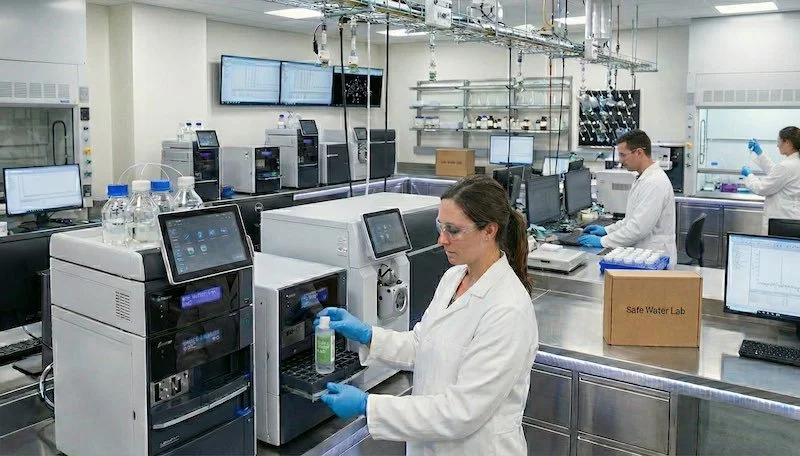
Analysis is conducted by our ISO/IEC 17025:2017 accredited laboratory partner using Laser Direct Infrared (LDIR) Chemical Imaging — a method that provides both size resolution and polymer-specific identification in a single pass. Compared to conventional FTIR microscopy, LDIR offers faster acquisition, lower operator variability, and reliable detection down to 20 µm.
Two outputs are generated from every sample:
Size Distribution Profile (20 µm – 5,000 µm) Particles are categorised by physical dimension across the full detection range. This data determines what micron rating is required for effective filtration of your specific sample.
Polymer Identification Each detected particle type is identified by chemical class. The panel screens for the most common residential plastics:
PolymerCommon SourcePE & PPWater tanks, food-grade containersPVC & PA (Nylon)Plumbing pipe and fittingsPETBottled water, synthetic textilesPS, PC, PMMA, PUIndustrial and domestic applications
Polymer identification allows contamination to be traced to a probable source infrastructure — a meaningfully different output from a total particle count alone.
Recommended Applications
Plumbing assessment: Quantifying microscopic polymer shedding from PVC, PEX, or aging elastomer-lined flexi-hoses.
Rainwater tank integrity: Identifying whether UV-induced degradation of poly-tank surfaces is introducing synthetic fragments into stored water.
Filtration validation: A quantitative before-and-after comparison confirming that a filtration system is capturing particles at the relevant size fractions.
Bottled water comparison: Establishing whether a tap or filtered source carries a lower particle burden than single-use PET bottled water.
What the Kit Includes
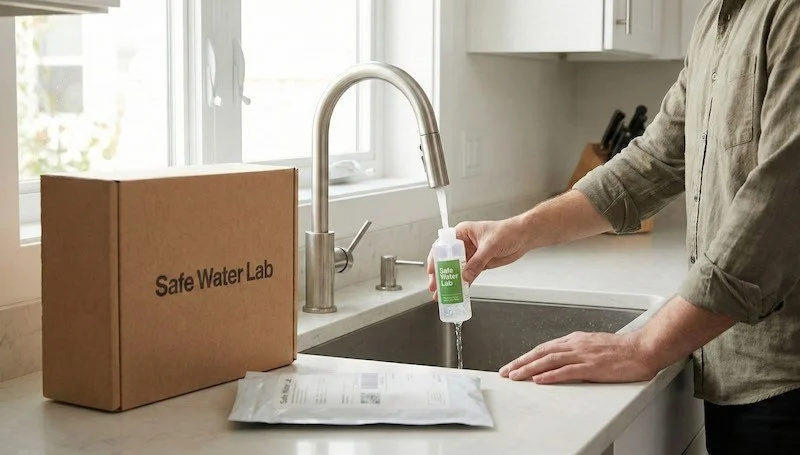
Specialised glass sampling vessels and seals — supplied to eliminate the risk of introducing secondary contamination during collection
Technical collection guide with instructions for capturing a representative sample
Pre-paid express return shipping to our accredited laboratory
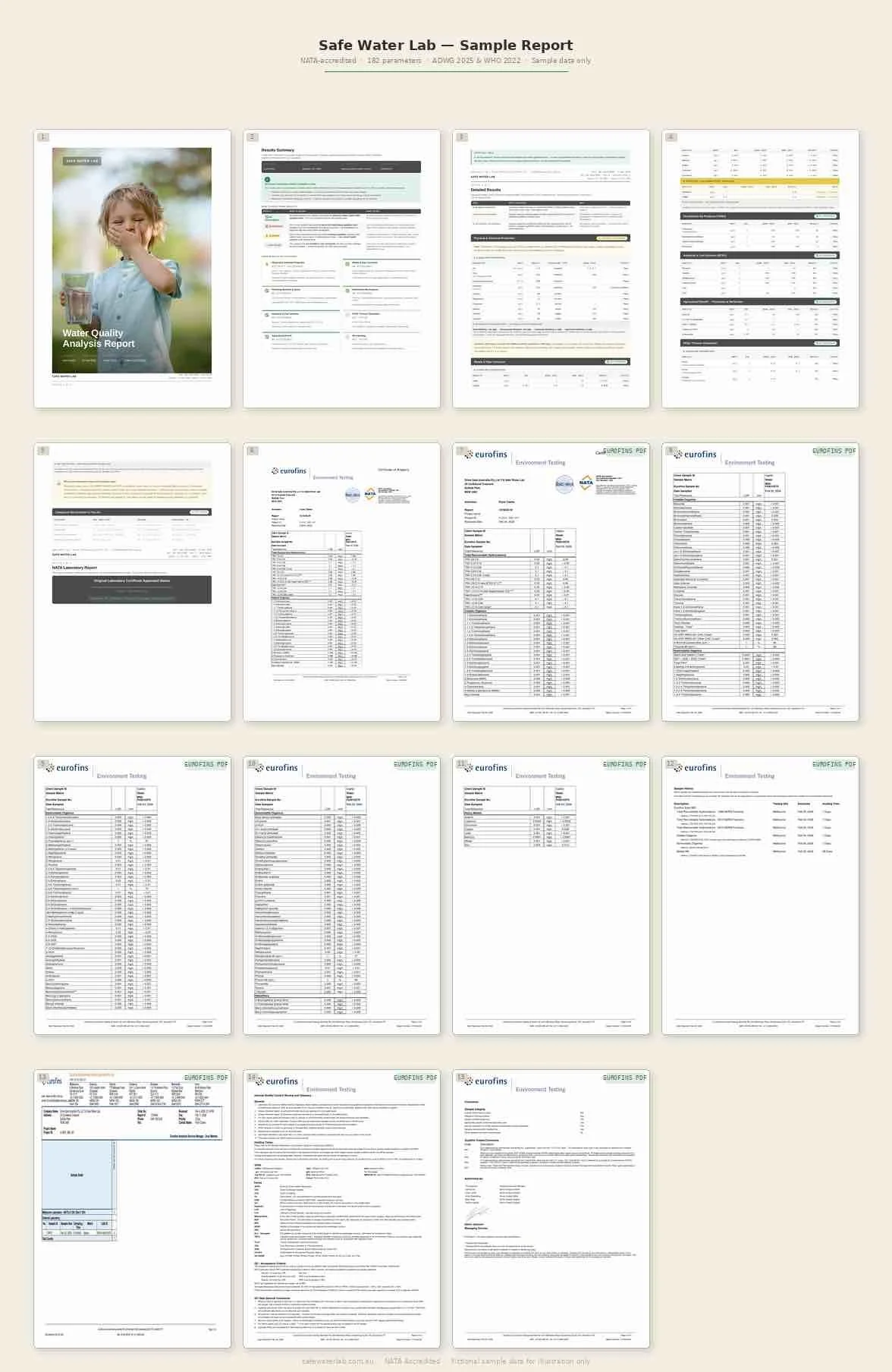
Accredited digital report detailing total particle counts, size distribution profile, and polymer identification by class
A Note on Regulatory Context
Microplastics are currently classified as an emerging contaminant. No health-based guideline values exist in the Australian Drinking Water Guidelines (ADWG). This analysis provides a quantitative, laboratory-verified baseline — the appropriate starting point for data-driven decisions on filtration, infrastructure maintenance, and ongoing monitoring.
Specialist microplastics water testing kit. Particle counts for 8 polymer types: PE, PP, PS, PVC, PET, PC, PMMA, PA.
Advanced Microplastics AnalysisISO/IEC 17025:2017 Accredited Laboratory
Microplastic particles are now recognised as a ubiquitous environmental contaminant. In residential water supplies, they enter via catchment runoff or through the degradation of plumbing and storage infrastructure — PVC pipework, PEX tubing, poly-tanks, and elastomer-lined flexi-hoses are all documented sources.
Laboratory Methodology
Analysis is conducted by our ISO/IEC 17025:2017 accredited laboratory partner using Laser Direct Infrared (LDIR) Chemical Imaging — a method that provides both size resolution and polymer-specific identification in a single pass. Compared to conventional FTIR microscopy, LDIR offers faster acquisition, lower operator variability, and reliable detection down to 20 µm.
Two outputs are generated from every sample:
Size Distribution Profile (20 µm – 5,000 µm) Particles are categorised by physical dimension across the full detection range. This data determines what micron rating is required for effective filtration of your specific sample.
Polymer Identification Each detected particle type is identified by chemical class. The panel screens for the most common residential plastics:
PolymerCommon SourcePE & PPWater tanks, food-grade containersPVC & PA (Nylon)Plumbing pipe and fittingsPETBottled water, synthetic textilesPS, PC, PMMA, PUIndustrial and domestic applications
Polymer identification allows contamination to be traced to a probable source infrastructure — a meaningfully different output from a total particle count alone.
Recommended Applications
Plumbing assessment: Quantifying microscopic polymer shedding from PVC, PEX, or aging elastomer-lined flexi-hoses.
Rainwater tank integrity: Identifying whether UV-induced degradation of poly-tank surfaces is introducing synthetic fragments into stored water.
Filtration validation: A quantitative before-and-after comparison confirming that a filtration system is capturing particles at the relevant size fractions.
Bottled water comparison: Establishing whether a tap or filtered source carries a lower particle burden than single-use PET bottled water.
What the Kit Includes
Specialised glass sampling vessels and seals — supplied to eliminate the risk of introducing secondary contamination during collection
Technical collection guide with instructions for capturing a representative sample
Pre-paid express return shipping to our accredited laboratory
Accredited digital report detailing total particle counts, size distribution profile, and polymer identification by class
A Note on Regulatory Context
Microplastics are currently classified as an emerging contaminant. No health-based guideline values exist in the Australian Drinking Water Guidelines (ADWG). This analysis provides a quantitative, laboratory-verified baseline — the appropriate starting point for data-driven decisions on filtration, infrastructure maintenance, and ongoing monitoring.