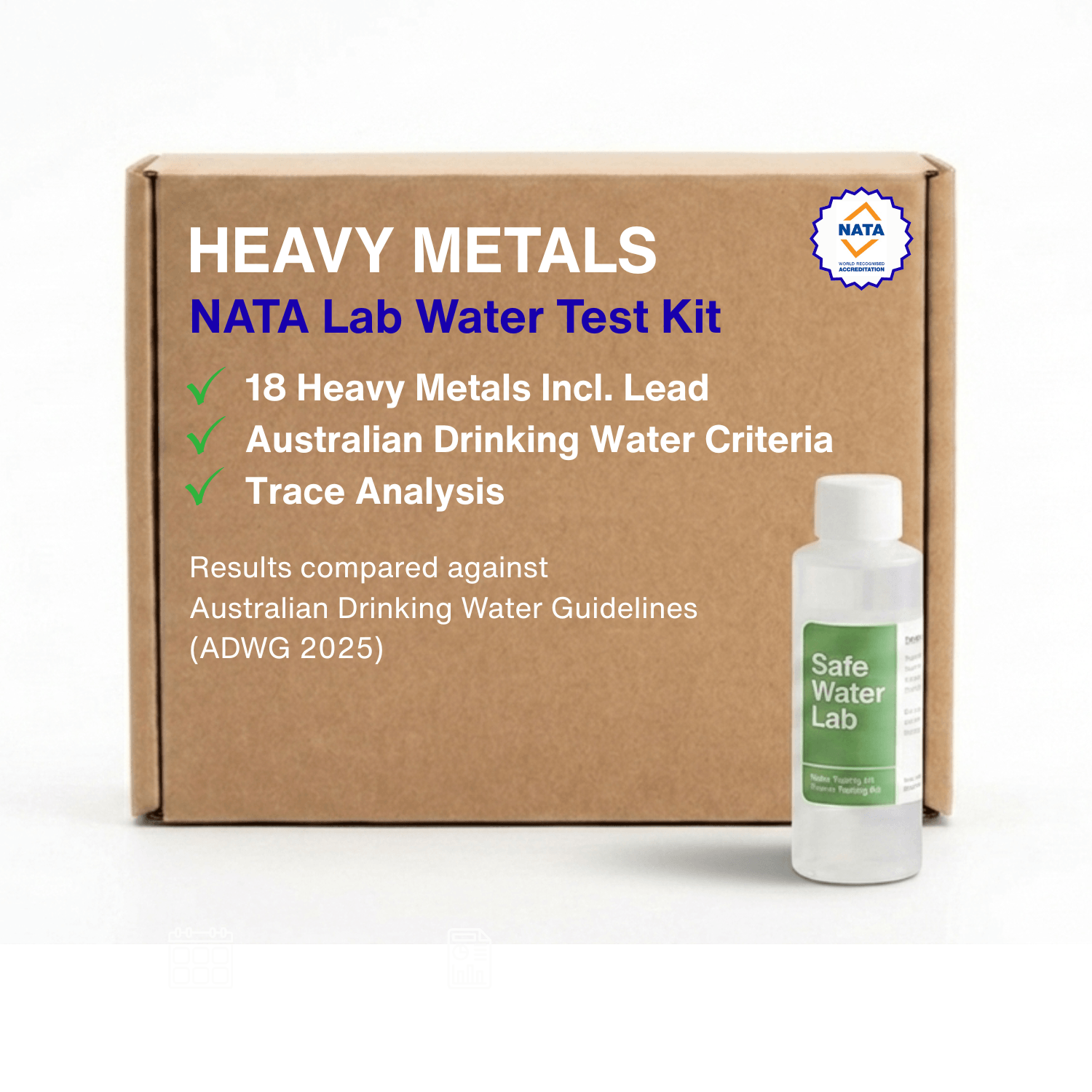
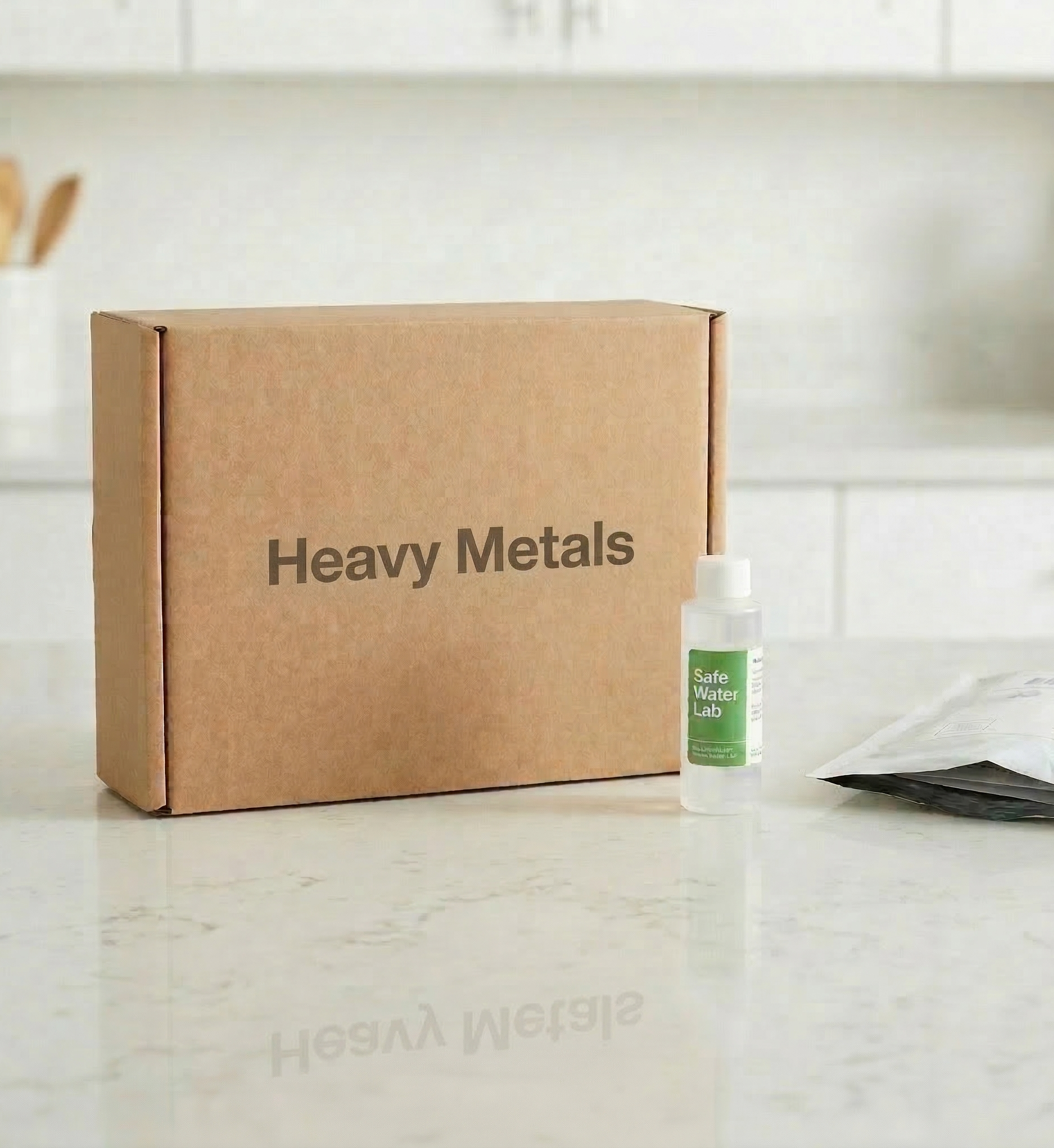
There is no safe level of lead. So the accuracy of your test matters.
The Australian Drinking Water Guideline for lead is 0.005 mg/L — just 5 parts per billion. Health authorities are clear that no level of lead exposure is considered safe, particularly for children and pregnant women, which is why the guideline sits at the very limit of what's measurable.
A contaminant present at 5 parts per billion is invisible, tasteless, and odourless. You cannot see it, taste it, or detect it without instrumentation precise enough to measure it. Our laboratory quantifies lead to 1 part per billion — well below the guideline, so a result showing your water is within the limit is backed by the accuracy to prove it.
If you're going to test for lead and other heavy metals, choose a test accurate enough to actually answer the question.
Non-lab tests can't answer the question that matters
Hardware-store test strips and consumer "water testers" react to a colour change or measure total dissolved solids. They cannot identify individual metals, and their detection limits are typically a hundred times higher than the health guidelines — meaning water that fails the real standard can still read "safe." For drinking water, where the contaminants that matter are present at parts-per-billion concentrations, a non-lab test is not a smaller version of a lab test. It simply cannot measure what you need to know.
The same standard trusted by councils and regulators
NATA — the National Association of Testing Authorities — is Australia's independent authority for laboratory accreditation. A NATA-accredited laboratory has been formally audited and proven competent to produce accurate, reliable results under the international standard ISO/IEC 17025. It is the same accreditation relied upon by Australian water utilities, councils, and environmental regulators.
When a result carries NATA endorsement, it means the method, the instruments, and the analysts have all been independently verified — and the result is traceable and legally defensible. It is the difference between an indication and proof. Every Safe Water Lab report includes the original NATA-accredited Certificate of Analysis from our partner laboratory, so your result is one you can actually stand on — for your own peace of mind, or for an insurer, council, or buyer.
Testing matters most if…
Lead and other metals rarely come from the water source itself — they leach from the plumbing inside your own home. Testing is especially worthwhile if your home was built or plumbed before the 1990s (lead solder and brass fittings were common), if you've noticed a metallic taste or discoloured water, if you rely on tank or bore water, or if you're confirming the water is safe for infants, children, or pregnant women — the groups most vulnerable to lead. From 1 May 2026, new plumbing in Australia must be lead-free — but existing homes are unaffected, and the only way to know your situation is to measure it.
How It Works
-
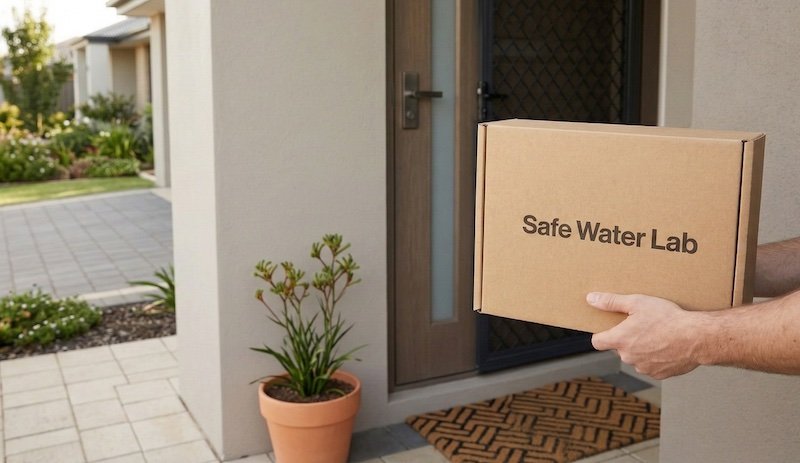
Step 1 - Select and purchase your test
We mail you a testing kit complete with laboratory testing bottles and step by instruction of how to collect your sample.
-
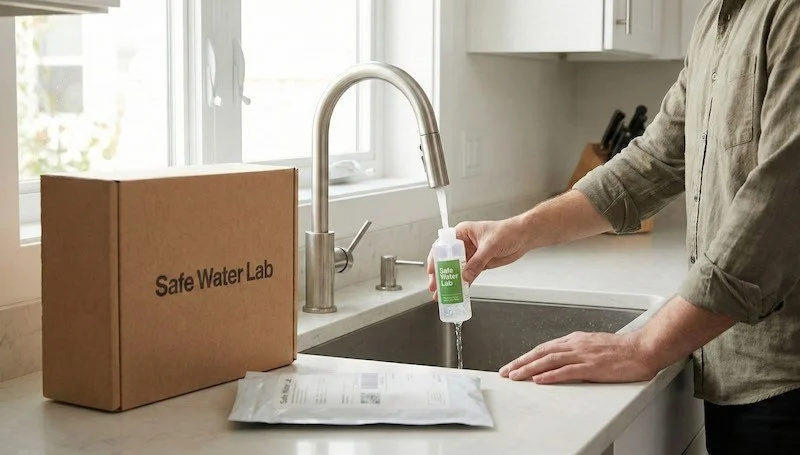
Step 2 - Collect a water sample
Fill the supplied laboratory testing bottles with a sample of your drinking water. Place the bottles in the supplied postage parcel complete with pre-paid express shipping return label and place in post.
-
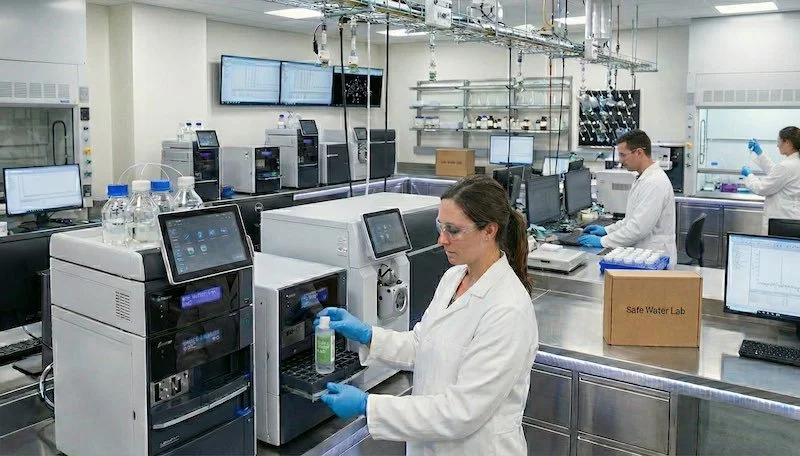
Step 3 - Laboratory Testing
Your water sample will be sent to a NATA accredited Australian laboratory for testing. Our laboratory partners typically complete the analysis within 5 business days.
-
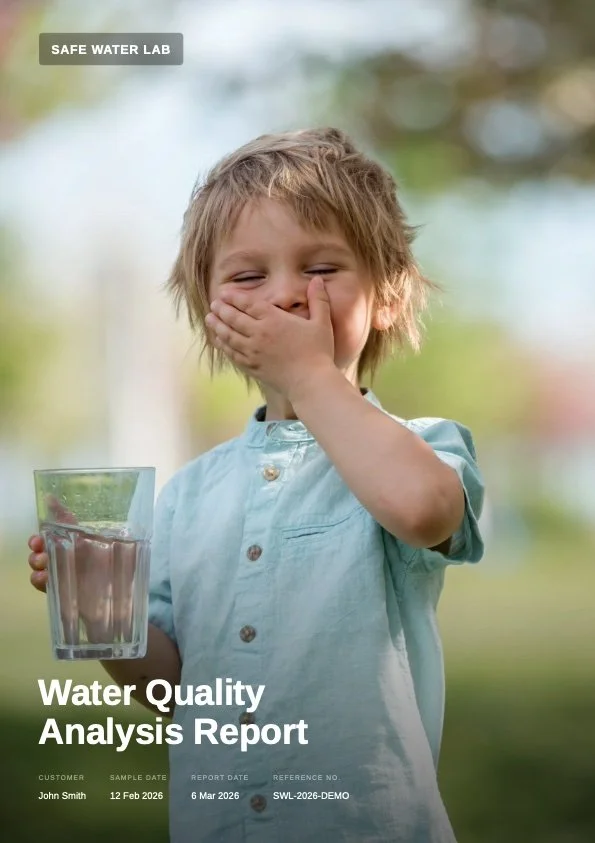
Step 4 - Receive your results
Your Water Quality Analysis Report is delivered as a digital PDF — prepared by an environmental scientist, with results benchmarked against Australian and international water quality guidelines, and the original NATA-accredited Certificate of Analysis included.
Your Report
The Clarity you need. Zero guesswork.
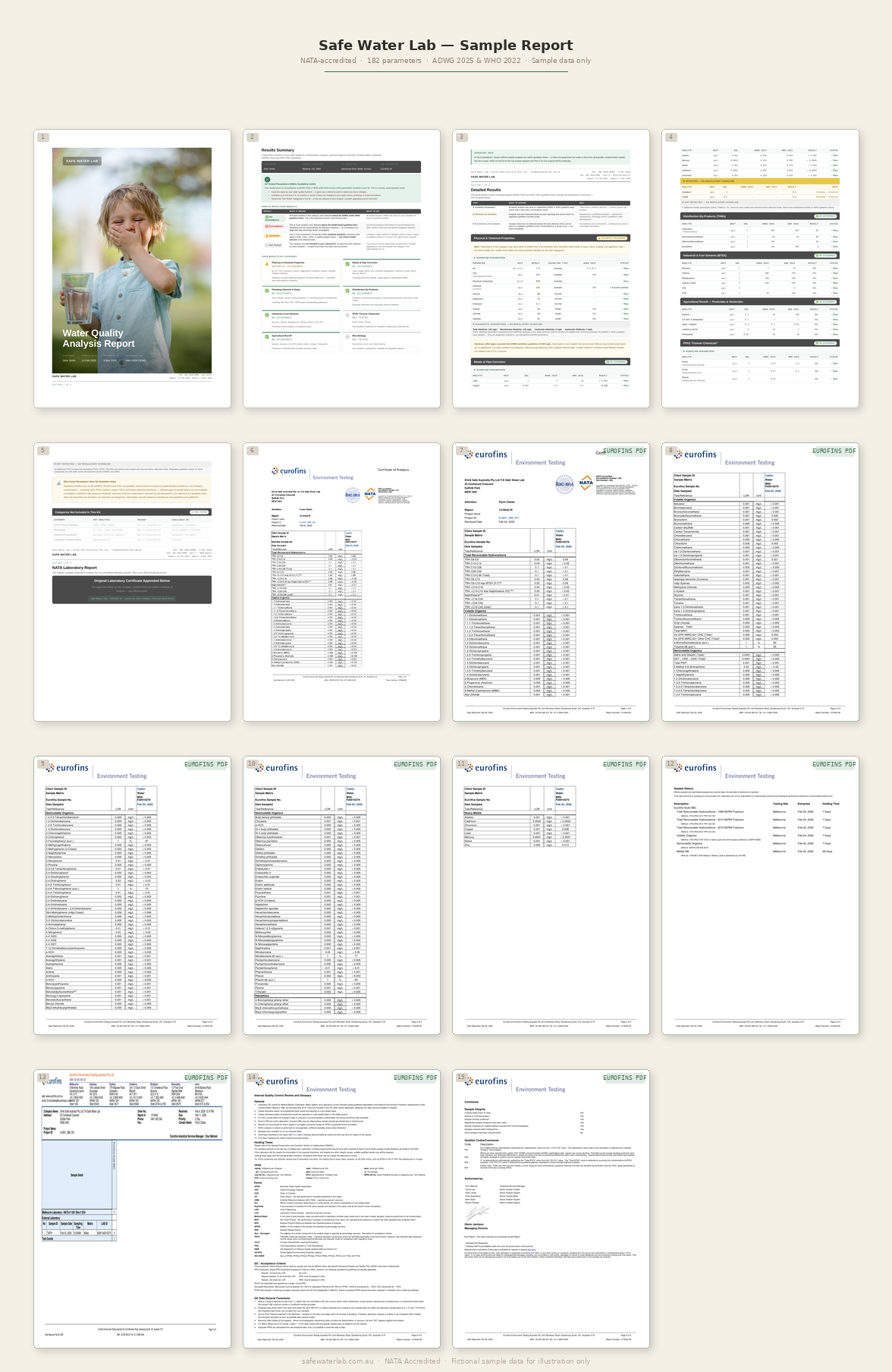
Every kit includes a Water Quality Analysis Report delivered as a digital PDF. Each report includes:
Results Summary — Colour-coded report card with pass/fail by contaminant category and next steps if you have an exceedance. Know where you stand in 60 seconds.
Detailed Results — All your results, compared against national and international drinking water safety limits.
Certificate — The original NATA-accredited Certificate of Analysis from the laboratory. Your official record.
The accurate, independent answer to what's in your water
Whether your water comes from a city main, a rainwater tank, or a bore, the question is the same — what's actually in it? We test for the contaminants that genuinely matter for your supply, interpret the results against the Australian Drinking Water Guidelines, and tell you plainly where you stand.
We don't sell filtration systems, water softeners, or treatment products — and we don't have a referral arrangement with anyone who does. Our results don't lead to a sale. They tell you what's genuinely in your water, and what you do next is entirely up to you. Many of our customers find they need no treatment at all once they see the results.
Safe Water Lab is operated by environmental scientists with backgrounds in water quality and contaminated land. We choose the right test method and detection limit for each contaminant, and write sampling instructions so your result reflects what's really in your water. Every report is read by someone who understands what the numbers mean, before it reaches you.
The contaminants that matter — lead, PFAS, pesticides, solvents — are present at parts-per-billion concentrations. A colour-change strip can't measure them. Every sample is analysed by a NATA-accredited Australian laboratory to trace detection levels, under the same ISO/IEC 17025 standard relied upon by councils, utilities, and environmental regulators.
Every result is colour-coded and benchmarked against the Australian Drinking Water Guidelines. Where a parameter exceeds a guideline, we explain what it means, what's likely causing it, and what your options are — in plain English. The original NATA-accredited Certificate of Analysis is included with every report, so your result is auditable and defensible.