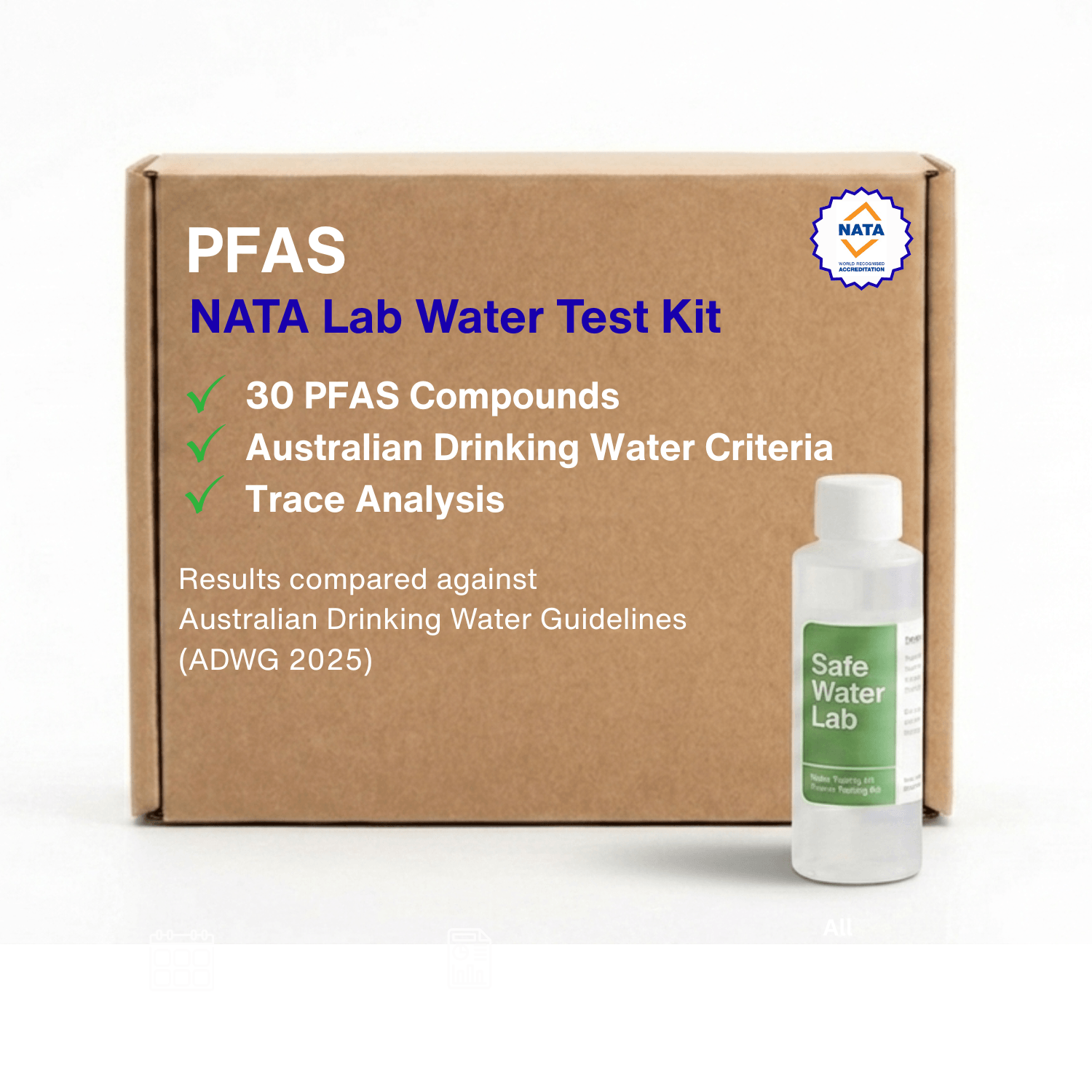
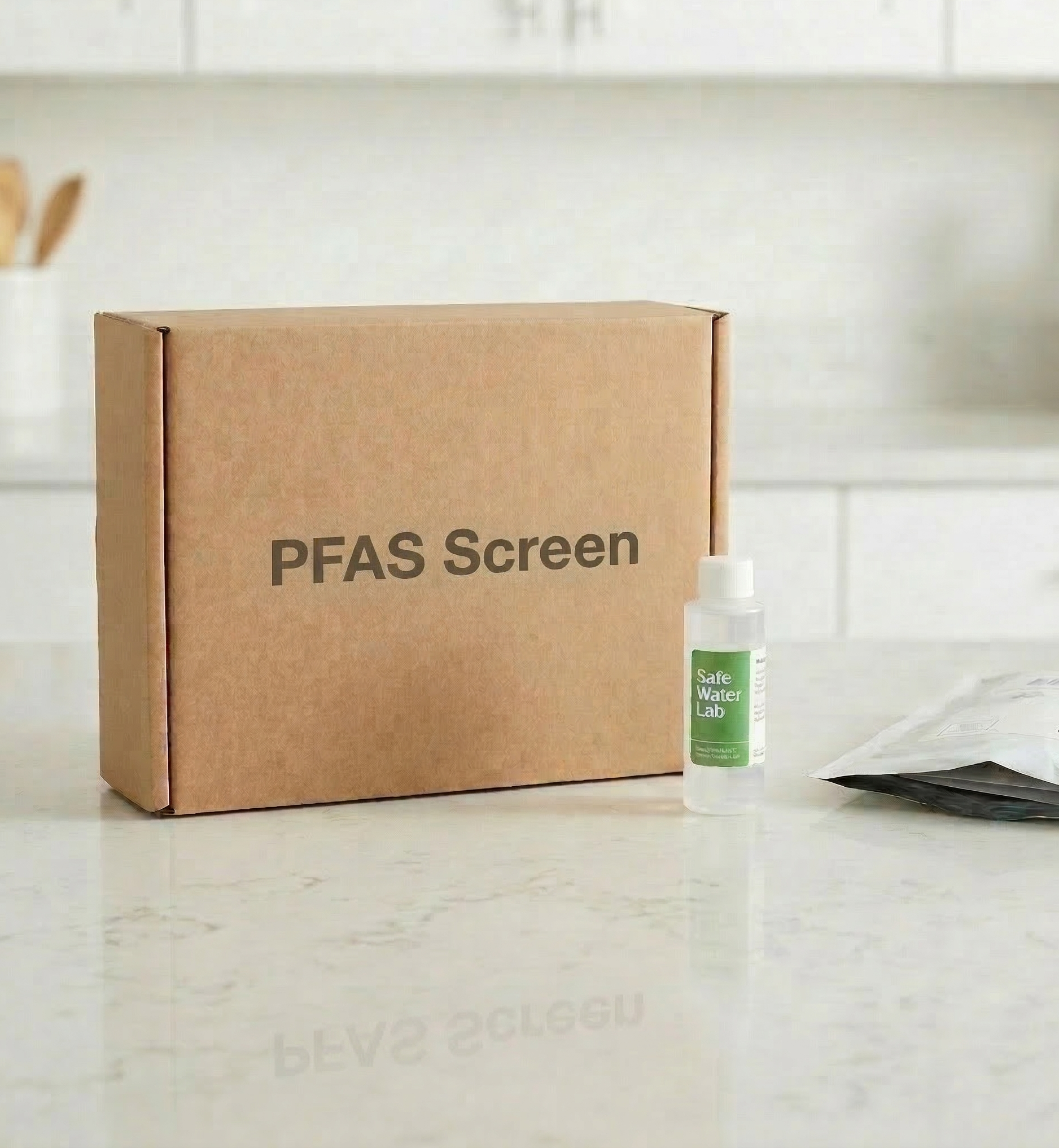
PFAS Screen - Water Test Kit

$399.00

NATA-accredited PFAS water testing kit. 30 compounds at trace detection (0.001 µg/L) including PFOS, PFOA, PFHxS, PFNA + 26 precursors.

Peer-reviewed monitoring data and recent national investigations have confirmed detectable PFAS concentrations in drinking water catchments across Australia's major cities and regional areas. These compounds are persistent — they do not break down in the environment or the body — and exposure thresholds under the Australian Drinking Water Guidelines (ADWG) have been revised downward as the health evidence base has matured.

A council water quality report tells you the system average. This test tells you what is coming out of your tap.

What the Kit Includes

  • Full laboratory analysis, no additional fees. NATA-accredited laboratory costs are included in the purchase price.

  • Pre-paid shipping. No additional costs at checkout. Sample collection and return logistics are fully managed.

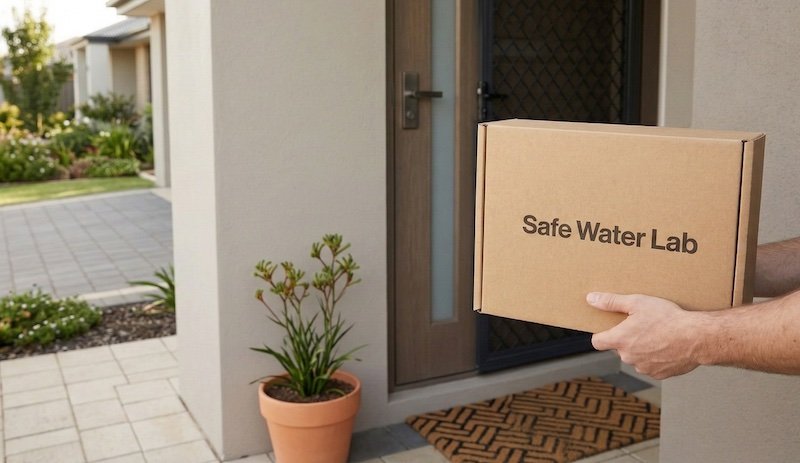
  • Complete collection kit. Delivered to your door with chain-of-custody instructions and all required sample containers.

  • Interpreted engineering report. Results are presented against current ADWG thresholds with plain-English annotations — not a raw data sheet.

Analytical Scope and Detection Capability

Most commercially available PFAS tests screen for two to three compounds. That is insufficient given what is now understood about PFAS as a chemical class.

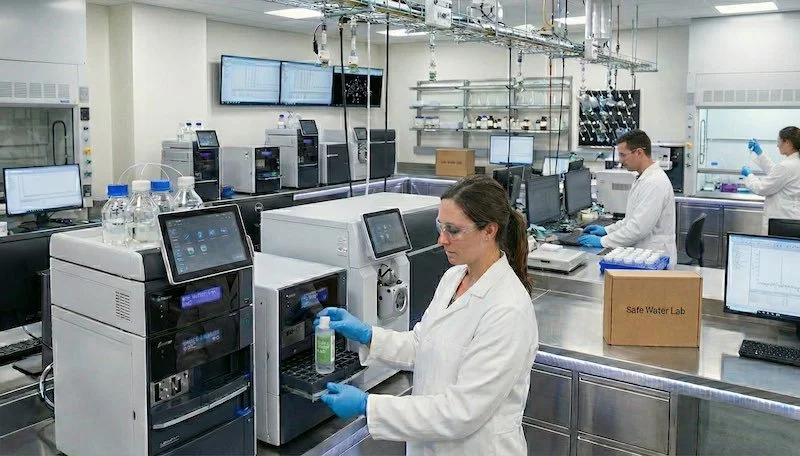
This panel screens for 30 distinct PFAS compounds, including PFOA, PFOS, and PFHxS, plus 27 additional precursors and sulfonates. Detection limits are 1–5 ng/L across the panel, achieved by our NATA-accredited laboratory partner using validated LC-MS/MS methodology. This is 5 times below the ADWG thresholds.

Recommended Applications

  • Municipal supply verification. Confirm your household result against ADWG thresholds, independent of council reporting averages.

  • Filtration system validation. Paired pre- and post-filter samples provide documented proof of PFAS removal efficacy for your specific system.

  • Private bore water assessment. Groundwater in agricultural and peri-urban areas carries elevated risk of PFAS plume exposure from land-use history.

  • Baseline documentation. Establishing a dated, laboratory-verified baseline is useful for ongoing monitoring or property due diligence.

Need a Broader Water Chemistry Profile?

If your assessment requires PFAS data alongside heavy metals, volatile organic compounds, or legacy plumbing indicators, our Advanced City Screen delivers a comprehensive analyte suite in a single submission.

NATA-accredited PFAS water testing kit. 30 compounds at trace detection (0.001 µg/L) including PFOS, PFOA, PFHxS, PFNA + 26 precursors.

Peer-reviewed monitoring data and recent national investigations have confirmed detectable PFAS concentrations in drinking water catchments across Australia's major cities and regional areas. These compounds are persistent — they do not break down in the environment or the body — and exposure thresholds under the Australian Drinking Water Guidelines (ADWG) have been revised downward as the health evidence base has matured.

A council water quality report tells you the system average. This test tells you what is coming out of your tap.

What the Kit Includes

  • Full laboratory analysis, no additional fees. NATA-accredited laboratory costs are included in the purchase price.

  • Pre-paid shipping. No additional costs at checkout. Sample collection and return logistics are fully managed.

  • Complete collection kit. Delivered to your door with chain-of-custody instructions and all required sample containers.

  • Interpreted engineering report. Results are presented against current ADWG thresholds with plain-English annotations — not a raw data sheet.

Analytical Scope and Detection Capability

Most commercially available PFAS tests screen for two to three compounds. That is insufficient given what is now understood about PFAS as a chemical class.

This panel screens for 30 distinct PFAS compounds, including PFOA, PFOS, and PFHxS, plus 27 additional precursors and sulfonates. Detection limits are 1–5 ng/L across the panel, achieved by our NATA-accredited laboratory partner using validated LC-MS/MS methodology. This is 5 times below the ADWG thresholds.

Recommended Applications

  • Municipal supply verification. Confirm your household result against ADWG thresholds, independent of council reporting averages.

  • Filtration system validation. Paired pre- and post-filter samples provide documented proof of PFAS removal efficacy for your specific system.

  • Private bore water assessment. Groundwater in agricultural and peri-urban areas carries elevated risk of PFAS plume exposure from land-use history.

  • Baseline documentation. Establishing a dated, laboratory-verified baseline is useful for ongoing monitoring or property due diligence.

Need a Broader Water Chemistry Profile?

If your assessment requires PFAS data alongside heavy metals, volatile organic compounds, or legacy plumbing indicators, our Advanced City Screen delivers a comprehensive analyte suite in a single submission.

PFAS & Filtration

Thinking of fitting a filter? Test first — and test it works.

PFAS are among the hardest contaminants to remove from water, and the filtration market is full of claims that don't hold up. Before you spend hundreds or thousands on a treatment system, it's worth understanding what actually works — and why testing is the only way to be sure.

01 Most common filters don't remove PFAS at all Standard fridge filters and basic carbon jugs are designed for taste, chlorine, and sediment — not PFAS. Only specific technologies, such as high-grade activated carbon and reverse osmosis, are capable of meaningfully reducing PFAS, and even then performance varies widely between products.
02 Manufacturer claims are rarely independently verified Few household filters sold in Australia carry independent certification for PFAS reduction. A claim on the box is not the same as a verified result on your water, with your PFAS profile, at your flow rate. The only way to know is to measure the water that comes out.
03 Performance degrades as the cartridge ages Even a filter that works when new loses capacity over time. Once the media is saturated, PFAS can pass straight through — often with no change in taste or flow to warn you. Periodic testing is the only way to confirm a system is still doing its job.

The smart approach: test your water first to see whether you have a PFAS issue at all — then, if you fit a filter, test again afterwards to prove it works. Because we don't sell filters, our results are genuinely independent.

Why Safe Water Lab

PFAS testing demands precision. This is built for it.

PFAS are measured at extraordinarily low concentrations — the strictest 2025 Australian Drinking Water Guideline, for PFOS, is just 8 nanograms per litre: eight parts per trillion. At that level, the credibility of a PFAS result depends entirely on the laboratory and the method behind it. This is not a test where "close enough" means anything.

30 PFAS compounds screened — not the usual two or three
1 ng/L Detection down to one part per trillion by LC-MS/MS
NATA Accredited to ISO/IEC 17025 — the regulator's standard
30 compounds, not three

Most consumer PFAS tests screen for two or three compounds. PFAS is a family of thousands, and the 2025 guidelines now cover PFOS, PFOA, PFHxS and PFBS individually. We screen 30 distinct compounds — PFOS, PFOA, PFHxS, PFNA and 26 further precursors and sulfonates — so you see the full picture, not a fragment of it.

Detection below the strictest limit

Our partner laboratory detects PFAS to 1 nanogram per litre using validated LC-MS/MS methodology — below even the tightened PFOS guideline of 8 ng/L. When your report shows a compound is below the guideline, that result is backed by instrumentation accurate enough to prove it.

NATA-accredited, independently verified

Every sample is analysed by a NATA-accredited Australian laboratory under ISO/IEC 17025 — the same standard relied upon by water utilities and environmental regulators. Your result carries an original Certificate of Analysis: auditable, traceable, and defensible.

Read by environmental scientists

Safe Water Lab is run by environmental scientists with backgrounds in water quality and contaminated land. Your result is interpreted and benchmarked against current guidelines by someone who understands what the numbers mean — and because we don't sell filters or treatment products, that interpretation is genuinely independent.

How It Works

  • Safe Water Lab Kit

    Step 1 - Select and purchase your test

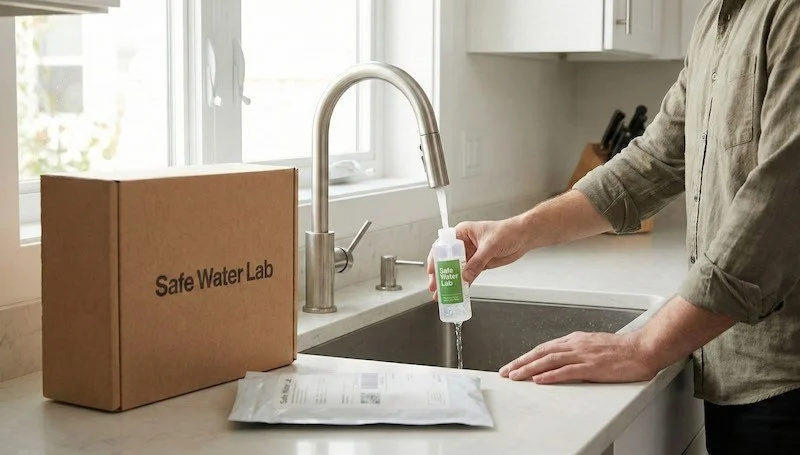
    We mail you a testing kit complete with laboratory testing bottles and step by instruction of how to collect your sample.

  • Illustration of a woman cleaning a kitchen countertop with cleaning spray, near the sink, with various cleaning supplies on the counter.

    Step 2 - Collect a water sample

    Fill the supplied laboratory testing bottles with a sample of your drinking water. Place the bottles in the supplied postage parcel complete with pre-paid express shipping return label and place in post.

  • Two scientists in a laboratory, one male and one female, working at a table with large glass flasks filled with blue liquid, surrounded by lab equipment and shelves with chemicals, with a clock showing 2:15.

    Step 3 - Laboratory Testing

    Your water sample will be sent to a NATA accredited Australian laboratory for testing. Our laboratory partners typically complete the analysis within 5 business days.

  • Safe Water Lab Report

    Step 4 - Receive your results

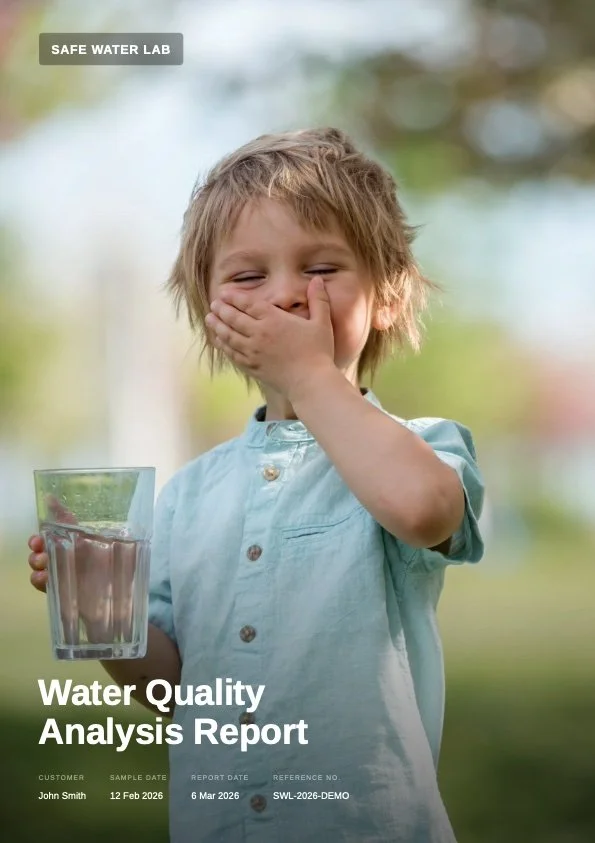
    Your Water Quality Analysis Report is delivered as a digital PDF — prepared by an environmental scientist, with results benchmarked against Australian and international water quality guidelines, and the original NATA-accredited Certificate of Analysis included.

PFAS in Australian Water

It's been found in catchments — and the guidelines are still catching up

PFAS has been detected in drinking water catchments across Australia, from major city supplies to regional and rural systems. In some cases the source has been traced to decades-old firefighting foam used in or near a catchment; in others, PFAS appears to be arriving through rainfall and runoff in urban areas. Most documented detections sit below the guideline values — but "below the average for the system" is not the same as knowing what's at your own tap.

The bigger issue is how new and how partial the rules still are. The Australian Drinking Water Guidelines were only revised in June 2025, and the framework is still maturing.

4 compounds have a guideline The 2025 guidelines set limits for just four PFAS — PFOS, PFOA, PFHxS and PFBS. PFAS is a family of thousands. Many compounds routinely detected in Australian water have no health guideline value at all, so they aren't measured against any standard.
1 in many tests are system averages Utility monitoring reports the average across a supply network, often sampled at the treatment plant. It cannot tell you what's reaching your individual property — particularly if you're at the end of a long distribution line or on a smaller local supply.
70 → 8 ng/L — the PFOS limit, tightened In 2025 the PFOS guideline was cut from 70 to just 8 nanograms per litre. Water that comfortably passed the old standard could be far closer to — or above — the new one. Older results may no longer mean what they once did.
None of this means your water is unsafe — most supplies test within the guidelines. But PFAS is invisible, tasteless, and odourless, the rules cover only a fraction of the compounds in use, and a system average says nothing about your specific tap. The only way to know what's actually in your water is to measure it directly.

Your Report

The Clarity you need. Zero guesswork.

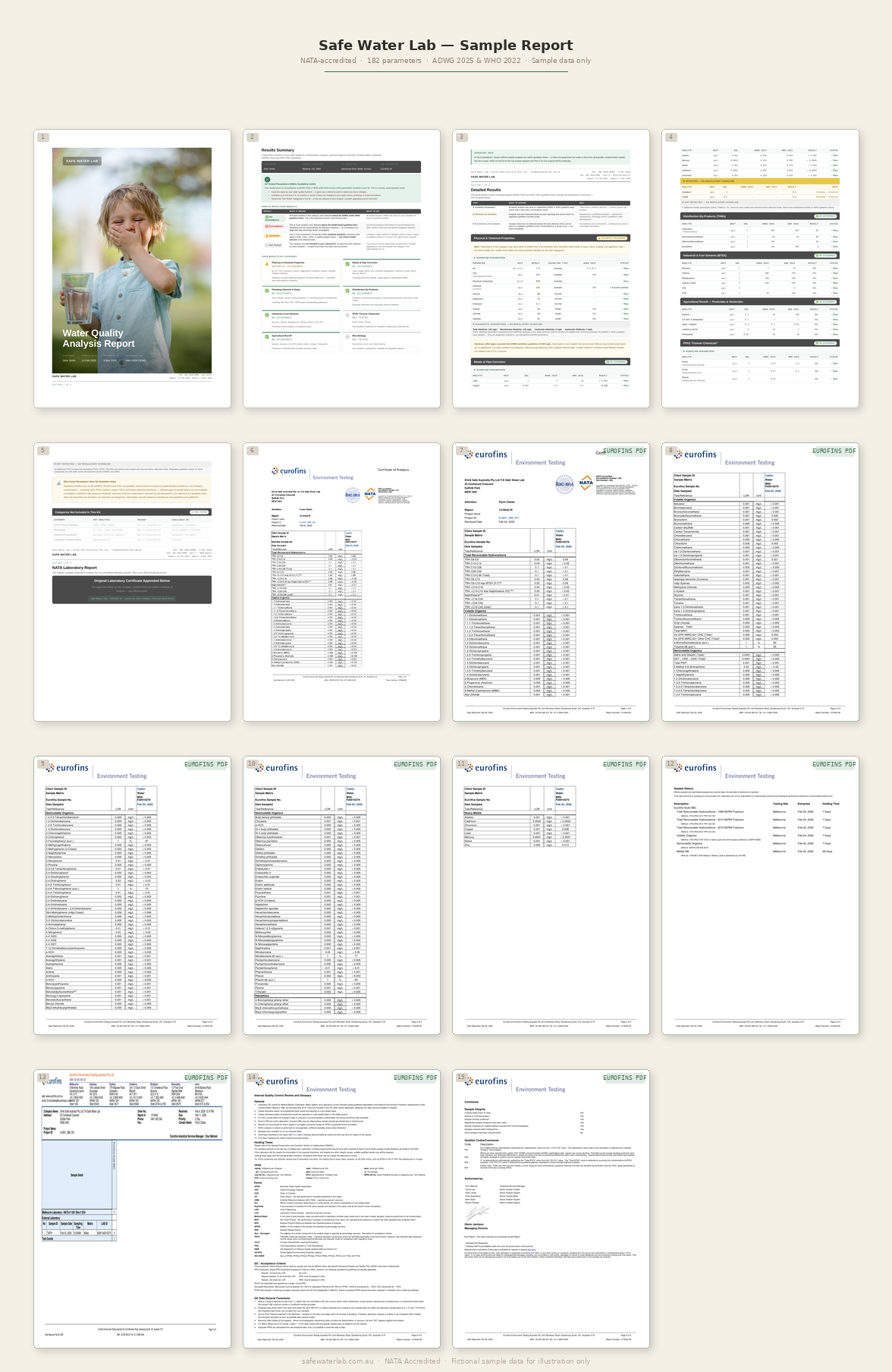
Every kit includes a Water Quality Analysis Report delivered as a digital PDF. Each report includes:

Results Summary — Colour-coded report card with pass/fail by contaminant category and next steps if you have an exceedance. Know where you stand in 60 seconds.

Detailed Results — All your results, compared against national and international drinking water safety limits.

Certificate — The original NATA-accredited Certificate of Analysis from the laboratory. Your official record.
  • "The testing process was super easy, and the final report was very clear and simple to read. It gave us the exact peace of mind we needed. Great product and great service"

    — Merrilyn M

  • Fantastic experience! We used this kit to check our rainwater for E. coli and heavy metals to ensure our filters were doing their job. Testing was incredibly easy, and the clear results gave us the confidence we were looking for. Highly recommend for anyone wanting to verify their water quality.

    — Mylo C.

  • "We got the answers we needed"

    — Rebekah

NATA-Accredited Samples analysed at our accredited Australian partner laboratory
3 Guideline Benchmarks Results compared against ADWG, WHO & ANZECC guidelines
5–7 Business Day Turnaround Measured from lab receipt of your sample
$0 Hidden Costs All shipping included — kit delivery and pre-paid return to the lab

Frequently Asked Questions